By Joey Barnes
The concrete canyons of a street circuit offer absolutely zero margin for error. Imprecision by mere inches can destroy an open-wheel race car.
For the engineers of Honda Racing Corporation USA (HRC US), the 2026 NTT INDYCAR SERIES calendar has thrown down an unprecedented gauntlet. The schedule features three brand-new, unchartered temporary street courses: Arlington, Washington D.C., and the upcoming Ontario Honda Dealers Indy at Markham on August 16.
Markham presents a tantalizing but terrifying blank canvas: a 2.19-mile, 12-turn temporary street circuit that has never seen a racing tire. There is no historical data, no onboard footage from previous years, and no rubber laid down on the asphalt.
Yet, when the green flag drops, the Honda-powered teams expect to roll off the transport trucks with cars dialed perfectly into the track's unique rhythm. How do you prepare for a place you have never been?
The answer lies deep within HRC's technical headquarters, inside a multi-million-dollar simulator that effectively bends reality.
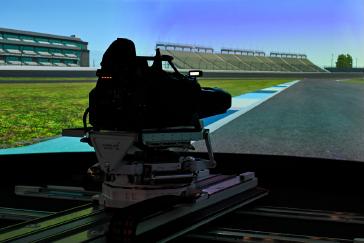
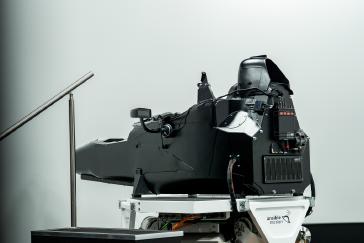
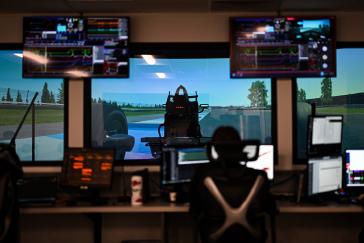
To bridge the gap between the unknown and the grid, HRC relies on its cutting-edge Driver-In-The-Loop (DIL) Simulator. This isn't a high-end video game; it is a hyper-realistic virtual laboratory designed to align virtual testing perfectly with the physical race car.
The HRC DIL simulator integrates a physical IndyCar cockpit featuring 360-degree yaw rotation and a 270-degree visual field with real Honda aerodynamic, laser-scanned tracks, and HRC-created tire models. To ensure the simulation is flawless, HRC US utilizes high-fidelity laser scanning technology combined with sophisticated rFpro software to create "digital twins" of real-world race circuits.
To maximize this piece of engineering wizardry, HRC announced in mid-June that 2024 INDYCAR Rookie of the Year Linus Lundqvist had joined the program as the official HRC Driver-In-The-Loop Simulator Development Driver. One of Lundqvist's tasks in his new role is logging thousands of virtual laps to shake down new tracks to help HRC develop and sharpen the simulation tools to take prediction capabilities one step further.
Davide Tarsitano, Head of Vehicle Performance at HRC US, knows that modeling a street circuit is a moving target. Even on familiar streets like Long Beach, human error plays a role.
"The city collaborates with IndyCar to put the barriers where they normally should be," Tarsitano said. "But in reality, because they're humans putting the barriers, those barriers change year on year. The track actually evolves just as a function of human error."
For a completely fresh venue like Markham, the challenge scales exponentially. The process begins the moment IndyCar confirms a track layout, often collaborating with veteran track designer Tony Cotman.
First, HRC takes basic architectural drawings defining the layout, pit lane, start-finish line, and safety runoff areas. HRC provides rFactor with this layout of the track, who then scan the streets of the circuit and provides HRC with a product that can be used at the DIL.
However, turning a scan into a racetrack requires intense mathematical filtering.
"Imagine these track models are just like clouds of points that are scanned," Tarsitano said. "You cannot drive on a cloud of points. You need to drive on the surface. Otherwise, there are basically holes everywhere. In the process of trying to fit a surface to this cloud of points, there can be elevation steps that are too aggressive for our vehicle model, or very noisy parts of the track. There is a whole process of fitting a surface through this cloud of points and filtering out a bunch of noise."
HRC aggressively pushes to have this finished digital model commissioned a tight but necessary eight weeks before the race event.
Even with a digital twin of Markham's layout, one massive, looming question mark remains.
Grip is a volatile, shifting metric at the best of times on any temporary circuit but in northern climates like Markham, rigid winters radically alter the morphology of the asphalt annually. Frost warps the ground, and city road crews frequently patch up broken stretches of street.
"If there are just a couple of corners that have been repaved because the street broke down during the winter, like a city patch, even if you have historical data to go off, the track grip is going to be completely off because of that repave," Tarsitano said.
Predicting how the Firestone tires will interact with un-raced Canadian asphalt is where engineering morphs into a dark art. It's a secret recipe that HRC keeps under lock and key.
"That's the part where I cannot disclose too much... because that process is quite IP," Tarsitano said. "And that is really the difference between teams that show up with their cars at Markham and they're going to be fairly close to reality, and the people that actually are starting the weekend on the back foot. You are going to probably get it quite wrong. It's about who gets it the least wrong that starts with an advantage."
While the engineering team works behind the scenes months in advance, the race teams and drivers enter the picture during a hyper-focused two-week window leading up to the event.
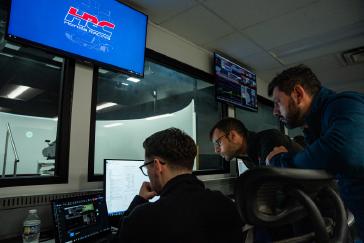
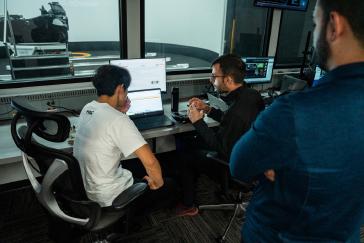
Before the final track model is even fully polished, HRC utilizes offline simulations to answer fundamental baseline questions—such as calculating top speeds (VMAX) to help teams select their initial gear ratios. Once the DIL model is live, the simulator bay becomes the busiest room in the company.
Drivers demand time in the simulator as close to the race weekend as possible so the muscle memory remains fresh before they walk into the Markham paddock.
In the hyper-competitive era between two brands, Honda has generally held the upper hand against rival Chevrolet at temporary street circuit events. For Tarsitano and his performance group, maintaining that supremacy at a brand-new track like Markham is deeply personal.
"I cannot understate how proud we are to be able to provide our teams with the best tools and the least wrong sort of guess about everything we provide," Tarsitano said. "Me and my team, we personally take a lot of pride in that. It's the culmination of so much hard work—a lot of data analysis, lots of assessments made on the track, on the car, on our sim tools."
# # #