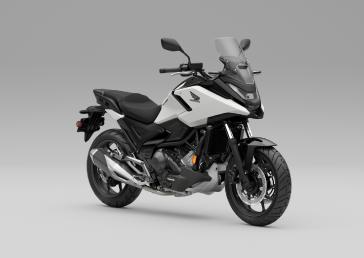
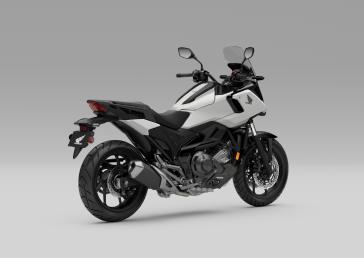
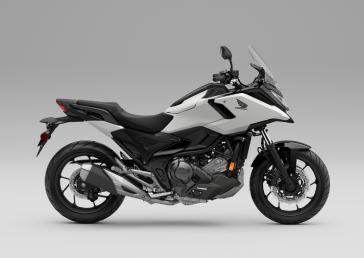
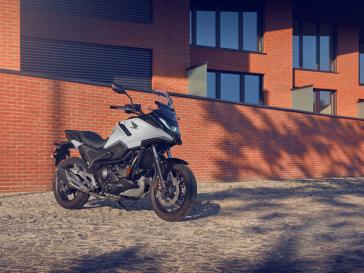
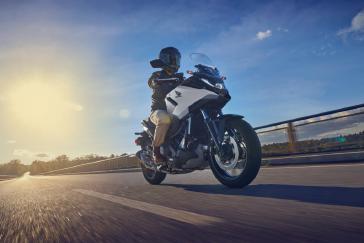
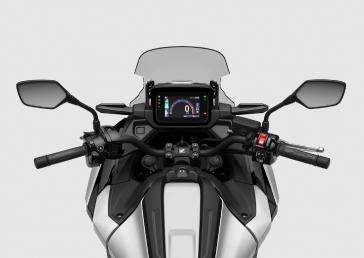
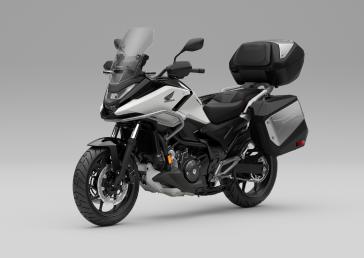
Versatile and practical, Honda's NC750X has always been an accomplished daily commuter that can double as a weekend explorer, and with important updates for 2025, it's more capable than ever. Included on the list of changes are refreshed styling, improved brakes, lighter wheels, an evolved dual-clutch transmission and a better TFT display. The result is a combination of versatility, performance and reliability that is sure to help the NC750X DCT retain its status as the motorcycling world's ultimate Swiss Army knife.
HISTORY
Since its 2012 introduction as the NC700X, this model has enjoyed consistent popularity as a groundbreaking, torque-laden, fuel-sipping twin-cylinder adventure bike with a relaxed riding position (thanks to a wide handlebar and a comfortable seat), compliant suspension and distinctive adventure-inspired styling.
Honda has continuously evolved the bike's successful, unique formula, with several upgrades over the years. A more adventurous aesthetic was introduced for 2016, along with new instruments and LED lighting. For 2018, it gained a performance boost via a 75cc increase in engine capacity, from 670 to 745cc, along with two-level Honda Selectable Torque Control and upgrades to the Dual Clutch Transmission.
In 2021 Honda improved practicality, do-it-all comfort and handling composure, while also introducing more spirited engine performance and lowering the vehicle weight and the seat height. Throttle by wire and electronic riding modes were added, and the HSTC was revised.
For model-year 2025, the NC750X continues its development path with increased use of sustainable materials in its construction, along with new styling, more technology, refined DCT response and better handling performance. As always, it remains a true Honda all-rounder.
NEW FOR 2025
- Refreshed styling and distinctive new LED headlight exude ruggedness.
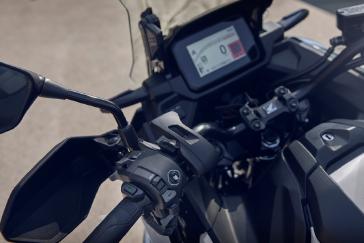
- New 5-inch TFT display offers Honda RoadSync smartphone connectivity.
- Application of Durabio™ and recycled materials in bodywork.
- Dual Clutch Transmission has improved starting/slow-speed response, using the same oil-pressure-estimation update as the 2024 Africa Twin.
- New dual axial-mount two-piston front-brake calipers.
- Lightweight "3 by 3" wheels, front and rear.
DESIGN/STYLING
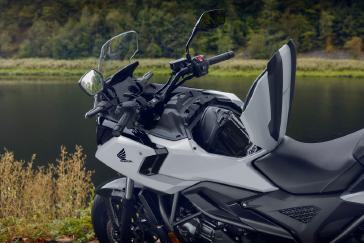
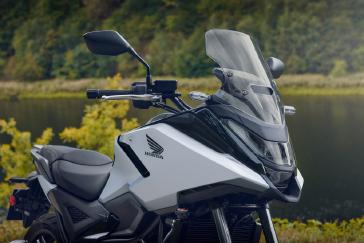
The 2025 NC750X adopts a dynamic, tough identity thanks to evolved upper and lower fairings with sharp creases and detail lines. Revisions to the fairings' structures, and how they attach to the bike, also improve their ease of removal and installation, and ultimately improve the overall ease of maintenance.
Other revisions include a new seat cover with added stitching, amplifying the bike's premium feel, and a revised cover for the storage area that sits where the tank usually would. A new LED headlight adds a robust frontal signature. The screen also offers excellent wind and weather protection, while slim side panels, covers and a revised tail unit emphasize a "mass-forward" stance. To tailor the bike to individual needs, a height-adjustable screen is available as an optional accessory, as is a new comfort seat, which uses additional urethane padding to provide a more comfortable ride.
This generation of the NC750X DCT makes increased use of the sustainable material Durabio (a bio-based polycarbonate resin), which has now been applied in the manufacture for some fairing parts, windscreen and other components. The NC750X DCT is the first Honda to utilize colored Durabio.
A unique NC feature—the storage area where the fuel tank traditionally sits—has 23 liters of volume, and careful internal shaping allows it to hold an ADV-style helmet. An optional USB socket can be installed (tucked away on the upper-left of the compartment), as can an optional divider that compartmentalizes the luggage space for improved useability.
The new premium, five-inch, full-color TFT screen uses optical bonding to improve visibility in bright sunlight. By sealing the gap between the cover glass and TFT screen with resin, glare is reduced, and visibility improved. The display is customizable between "Bar," "Circle" and "Simple" display patterns, and it offers smartphone connectivity via Honda RoadSync.
Honda RoadSync, along with a new simplified, easy-to-use, backlit four-way toggle-switch on the left side of the handlebar, allows straightforward, on-screen turn-by-turn navigation, as well as the option (via a Bluetooth helmet headset) for the rider to make calls, listen to music or receive voice feedback of weather conditions. All an owner needs to do is download the free Honda RoadSync app from either the App Store or the Play Store, connect to the NC750X DCT, and go.
A "wave" key features the Honda Ignition Security System (HISS). If the ID chip embedded in the key and the ID in the Engine Control Unit (ECU) do not match, the engine will not start.
ENGINE / DRIVETRAIN
The NC750X DCT's liquid-cooled, SOHC 8-valve parallel-twin-cylinder engine is designed to offer punchy performance in the low to midrange. Its relatively long-stroke architecture and specially shaped combustion chambers combine with the high-inertial-mass crankshaft to produce large amounts of effortless torque from very low rpm, while a forward cant lowers the center of gravity for optimum stability.
Twin balancers counteract vibration from higher-rpm inertia, for an engine that is not only smooth-running, but has a distinctive "throb" thanks to its 270-degree crank and uneven firing intervals. Bore and stroke are set at 77 x 80mm. Where possible, components are made to do more than one job: the camshaft drives the water pump, while one of the balancer shafts drives the oil pump. By minimizing the number of parts in this way, the engine is kept light, efficient and reliable.
A lightweight, pentagon-shaped muffler uses two chambers joined by a hole-punched link pipe, which works with a final resonator chamber to create a deep, distinctive sound and exhaust pulse. The built-in catalyzer has a two-layer structure for cleaner emissions.
Transmission
In the world of powersports, Honda first offered a Dual Clutch Transmission on the 2009 FourTrax Rancher multipurpose ATV, followed by the 2010 VFR1200F sport-touring motorcycle. Since then, the technology has been offered on Honda touring machines, cruisers, ATVs and side-by-sides. While similar systems can be found in high-performance sports cars, Honda pioneered the use of DCT in the powersports world and has accumulated experience and improved the technology along the way.
Honda's unique-in-motorcycling Dual Clutch Transmission technology has evolved over the years and offers easy, direct gear changes through constant refinement. As is the case in other Honda DCT models, the system uses two clutches: one for start-up and first, third and fifth gears; the other for second, fourth and sixth, with the main shaft for one clutch located inside the other for compact packaging.
Each clutch is independently controlled by its own electro-hydraulic circuit. When a gear change occurs, the system pre-selects the target gear for the clutch not currently in use. The first clutch is then electronically disengaged, as the second clutch simultaneously engages.
Surpassing the operating parameters of the previous generation DCT, the new version estimates the oil pressure of the clutch piston chamber and completely reviews the way feedback gain is applied (rather than just relying on an oil pressure sensor upstream of the clutch piston), resulting in improved, more delicate clutch response. The DCT also features a dedicated setting for extremely low-speed riding.
The result is consistent, fast and seamless gear changes. Furthermore, as the twin clutches transfer drive from one gear to the next with minimal interruption of the transfer to the rear wheel, any gear-change shock and pitching of the machine is negligible, making the change feel direct as well as smooth. Extra benefits include durability (as the parts are less likely to be damaged via flawed shift-lever operation), reduced possibility of stalling, reduced rider stress and fatigue, and extra mental bandwidth for better concentration on (and enjoyment of) all other aspects of riding.
Through throttle-by-wire control, four automatic shifting schedules are available: Level 1 is the most relaxed, with upshifts and downshifts operating at relatively low rpm; it is linked with the RAIN riding mode. Level 4, on the other extreme, shifts up at higher rpm and also downshifts earlier, for more engine-braking effect; it is linked with the SPORT mode. Level 2 is linked with STANDARD riding mode, with Level 3 situated between STANDARD and SPORT.
The USER mode functionality allows the rider to select any of the DCT shift patterns with the preferred variations of the other parameters—power delivery, engine braking, and HSTC.
With the DCT system, the rider may also choose Manual mode, using paddle-style triggers on the left handlebar to change gears.
Engine Electronics
With throttle by wire managing engine performance and character, there are three modes for the rider to choose from for various riding conditions, with preset combinations of settings for Power, Engine Braking and Honda Selectable Torque Control. (Mode selection is managed between the left-hand switch cluster and the TFT display.):
- SPORT gives more aggressive delivery of engine power and braking, with low HSTC intervention and DCT mode 4.
- RAIN delivers engine power and braking least aggressively, has high HSTC intervention and Level 1 for the DCT shift pattern.
- STANDARD delivers a balanced middle point for engine-power delivery, engine braking and HSTC intervention, plus mode 2 for the DCT.
- USER offers custom options of low/medium/high for delivery of engine power and engine braking, low/medium/high/off for HSTC, and four different shift patterns for DCT.
Honda Selectable Torque Control is fitted as standard. It offers soft, intuitive control as it manages rear wheel torque thanks to TBW, over three levels:
- Level 1 allows the minimum intervention for some rear wheel spin—on gravel or dirt, for instance.
- Level 2 is the default setting and provides confidence-inspiring traction for general riding conditions.
- Level 3 provides maximum intervention, for slippery conditions, and it links to the new RAIN mode settings.
HSTC can also be switched off.
CHASSIS / SUSPENSION
Honda's development engineers carefully designed the light, strong tubular-steel diamond frame, giving consideration to the battery and airbox locations in order to free up storage space. The riding position is upright and neutral, with a high viewpoint for enhanced hazard perception. This adventure-style arrangement contributes to the bike's exceptional low-speed handling and balance, as do the low center of gravity and generous steering lock.
Rake is 27 degrees and trail is 4.33 inches, while wheelbase is 60.3 inches. The front/rear weight distribution is 48/52, and the curb weight is 497 pounds (including required fluids and a full tank), contributing to the bike's prowess on city streets or even longer rides through tight, twisty canyons. Further increasing the bike's practical performance, the seat height is 31.6 inches.
Suspension
The 41mm fork has 4.7 inches of travel and uses Showa's Dual Bending Valve design, with settings optimized for both compression and rebound damping. This enables the damping force to act in accordance with piston speed in low-speed compression and rebound situations, improving ride quality and comfort.
The single shock features a spring-preload adjuster system with 4.7 inches of wheel travel. It operates through Pro-Link® arrangement that offers an optimized balance of a soft initial stroke (for dealing with smaller bumps) and excellent control.
Brakes
Up front, the single two-piston brake caliper and 320mm petal-style disc of the previous design have been replaced by dual two-piston axial-mount calipers and 296mm floating discs, offering confidence-inspiring braking power in all conditions. As before, rear braking is provided by one single-piston caliper and a 240mm disc. Lightweight two-channel ABS provides powerful and confident braking, even on slippery or wet road surfaces.
Wheels
New "3 by 3" spoke cast-aluminum front and rear wheels (sizes 17 x 3.50-inch and 17 x 4.50-inch) wear 120/70 ZR17 and 160/60 ZR17 tires and save four pounds, negating the extra weight of the revised front braking system.
Honda ACCESSORIES
The NC750X can be further tailored to the rider's needs with 22 accessories. Some new additions to the lineup this year include a Comfort Seat, Handguards and improved Panniers.