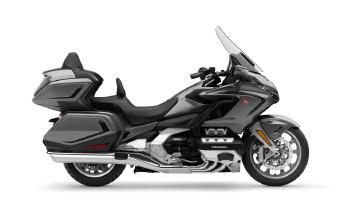
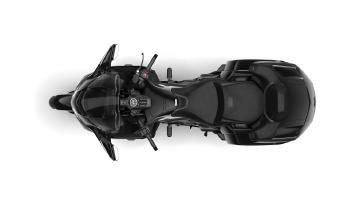
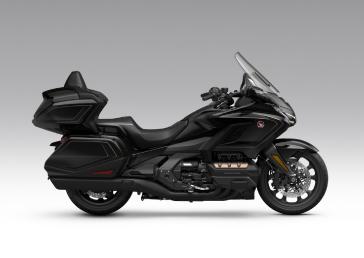
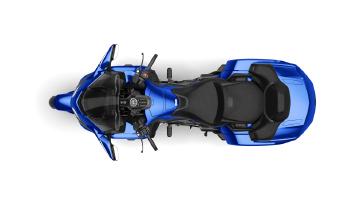
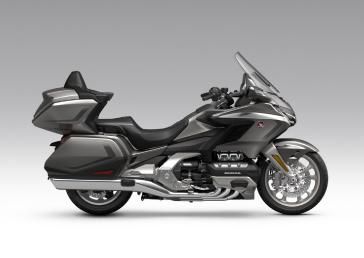
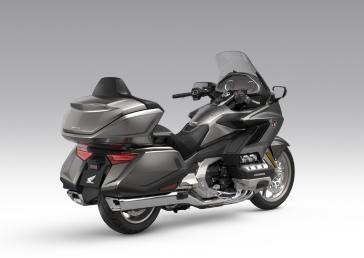
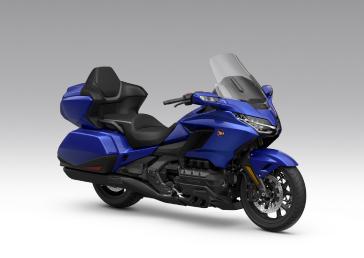
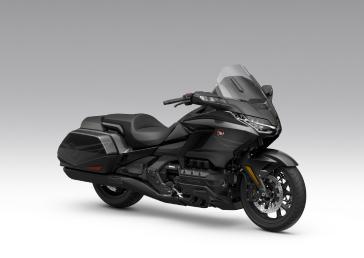
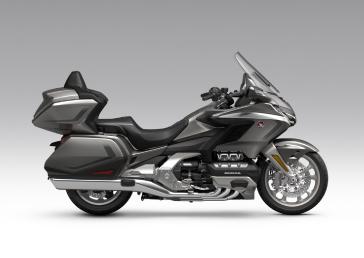
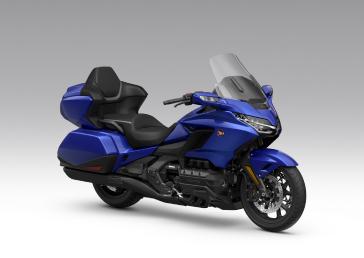
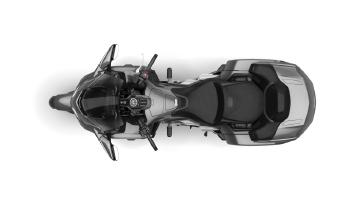
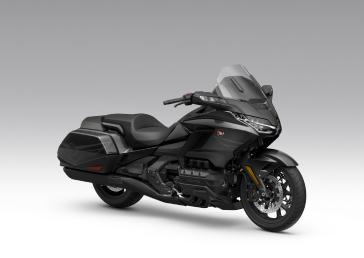
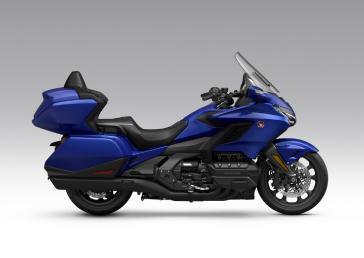
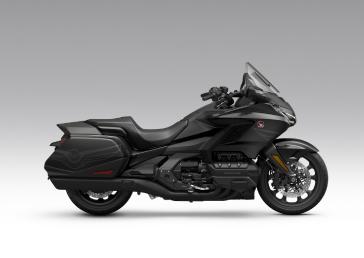
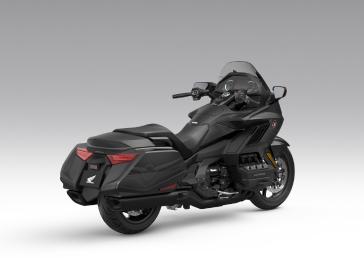
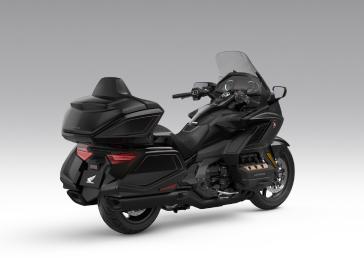
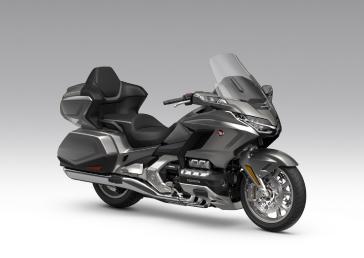
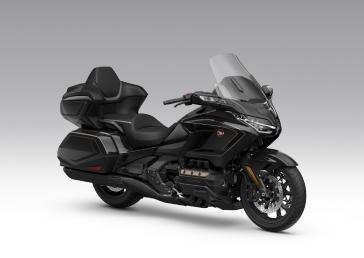
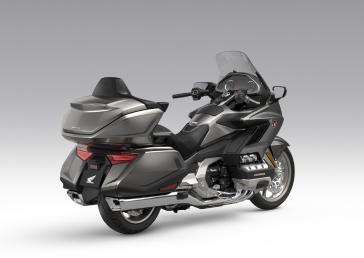
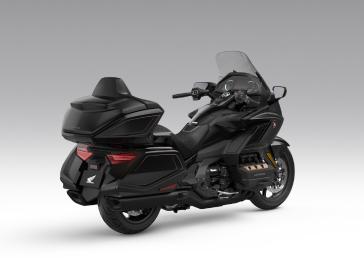
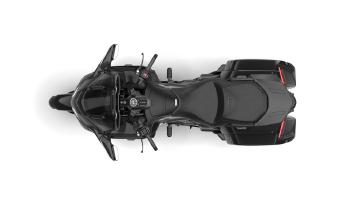
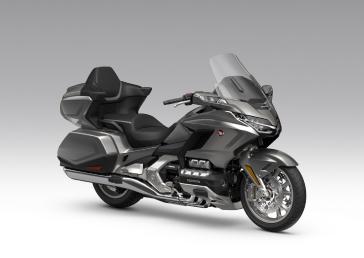
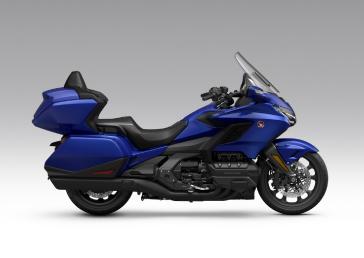
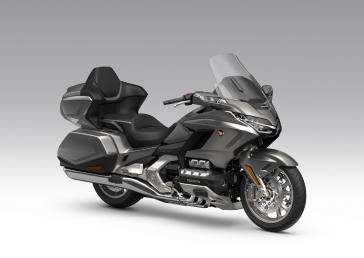
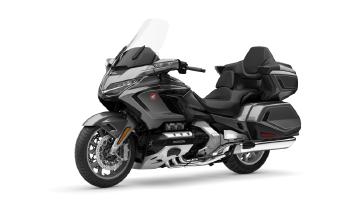
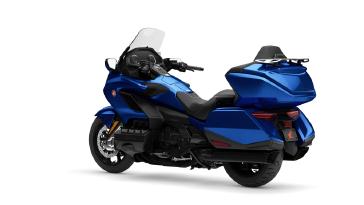
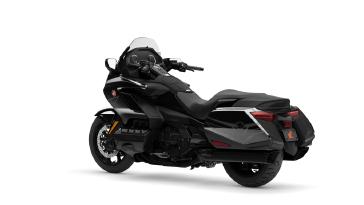
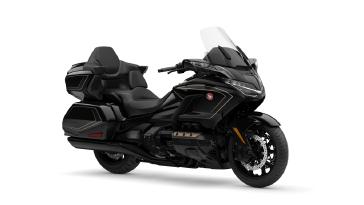
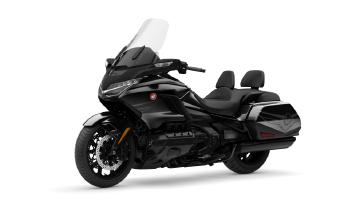
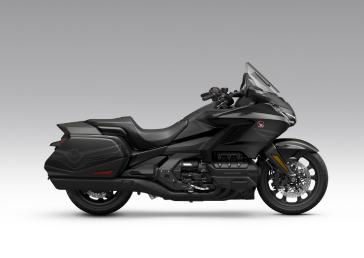
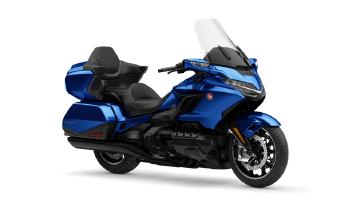
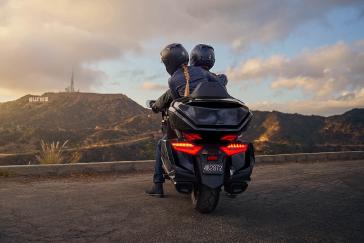
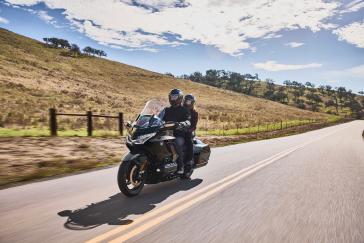
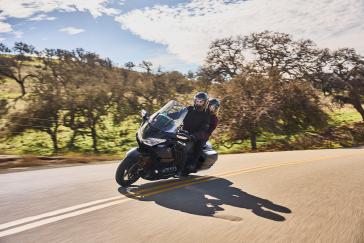
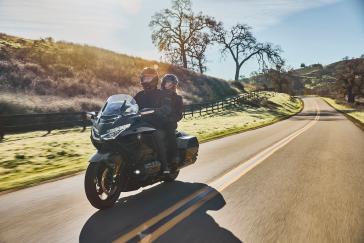
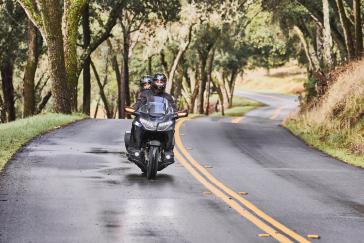
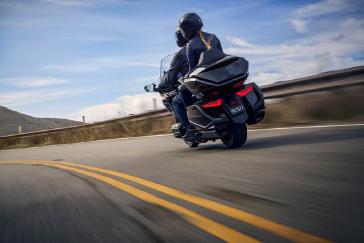
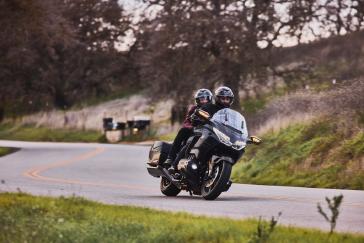
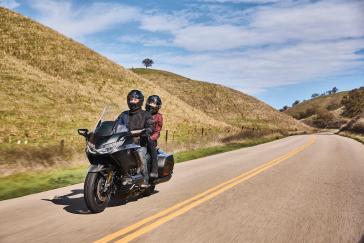
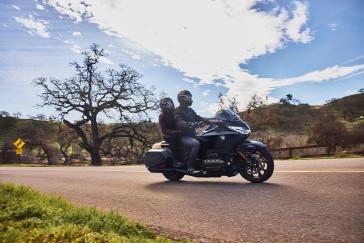
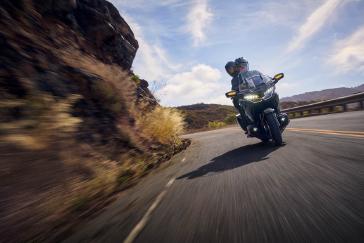
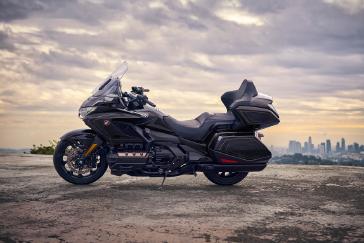
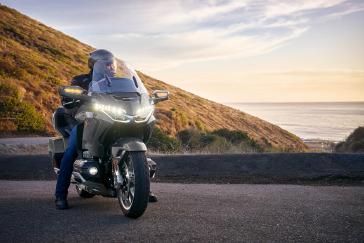
Honda's Gold Wing has been synonymous with premium motorcycle touring for more than 50 years, combining exceptional comfort, sophisticated technology and effortless performance. At the heart of the Gold Wing is its legendary horizontally opposed six-cylinder engine, complemented by a refined chassis and an array of premium features that enhance every ride. Whether embarking on a weekend getaway or a cross-country journey, the Gold Wing delivers the long-distance comfort and composed performance riders expect from Honda's premier touring motorcycle.
HISTORY
Designed with the simple but audacious objective to be the best motorcycle ever built, the original, 1975 GL1000 Gold Wing was embraced by customers as a touring machine, with many outfitting their GLs with aftermarket luggage and a front fairing. This inspired the future direction for what would quickly become an iconic platform.
For 1980, Honda's all-new follow-up model—the GL1100 Gold Wing—established what would become a regular practice with milestone Gold Wings, as the model grew significantly. In addition to its larger engine, the motorcycle had a longer wheelbase, more room for the rider and passenger, and increased fuel capacity (though it was lighter). Taking a lead from customers, Honda also added a touring-specific Interstate version that came with a factory-installed fairing and luggage, as well as other touring-focused features like a radio, although an unfaired version was also still offered.
Capitalizing on the successful reception of the Gold Wing Interstate, Honda added an Aspencade version in 1982 (named after a popular New Mexico motorcycle rally), which introduced the concept of luxury touring, with a larger seat, additional storage, a CB radio (previously only available as an accessory) and a special paint scheme.
The 1984 GL1200 Gold Wing was again larger, its engine growing by 97cc and offering more power and torque. The swingarm and wheelbase were longer as well, and improved handling and comfort were made possible via a stiffer frame, repositioned engine and smaller wheels.
For 1988, the GL1500 Gold Wing underwent what at the time was the most comprehensive model development in Honda's history, with a new six-cylinder engine delivering the power and smoothness for which the model would become renowned. The chassis was new as well, redefining the limits for handling and comfort in a touring motorcycle. Also of note were the increased fuel capacity, improved brakes and seamless fairing. Production was in the USA, at Honda's Ohio plant.
The sensational 2001 GL1800 Gold Wing brought fuel injection, an aluminum twin-spar frame and optional ABS braking, and its 20 patents were a hint at the extensive technological innovations. Developed under Masanori Aoki, this next-generation GL featured an engine that was 312cc larger than that of its predecessor, but it also had an added fun factor, attaining sport-like acceleration and handling. In 2006, Honda introduced a version with navigation and the world's first motorcycle airbag, and in 2009, XM Satellite radio was added.
The evolution of Honda's most storied touring model continued in 2018, with the introduction of an all-new Gold Wing. Built on the same pillars of reliability and easy-to-use performance that had driven the platform to the forefront of the touring category year after year, this new edition took each of the prerequisites for a good touring machine and advanced them across the board. Lighter, more compact and more technologically advanced, this was a fun-to-ride Gold Wing that could just as willingly tackle city streets as it could take riders beyond the next horizon. Since then, the Gold Wing has received regular updates, keeping it firmly at the forefront of the touring market.
TRIM LEVELS
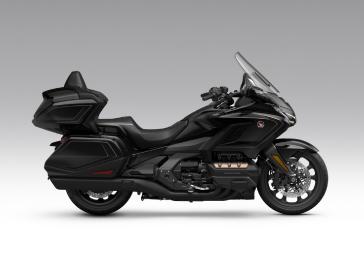
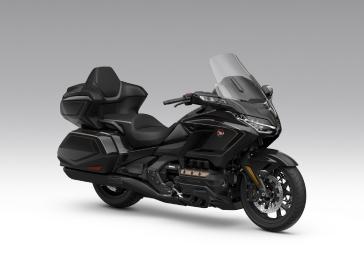
- Gold Wing Tour: Focused on long-distance riding, this version features a manual transmission, a tall windscreen and full luggage, including side bags and a top case.
- Gold Wing Tour Automatic DCT: Identical to the Tour in most ways, this version features Honda's advanced Dual Clutch Transmission (DCT), also offered on other Honda models but particularly popular in the touring category.
- Gold Wing Tour Airbag Automatic DCT: This iteration starts with the Gold Wing Automatic DCT and adds Honda's high-tech safety airbag.
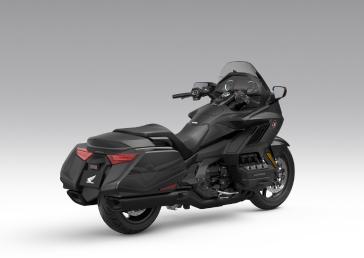
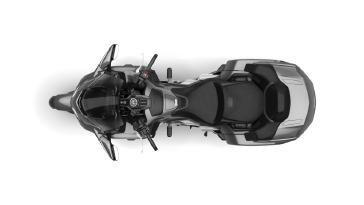
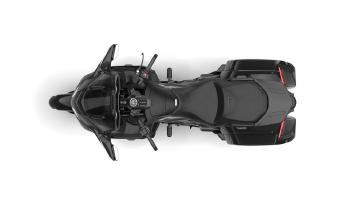
- Gold Wing: Compared to the Gold Wing Tour, this “bagger”-style version has a shorter windscreen and no top case.
- Gold Wing Automatic DCT: Identical to the standard Gold Wing, this configuration adds Honda's DCT.
DESIGN / STYLING
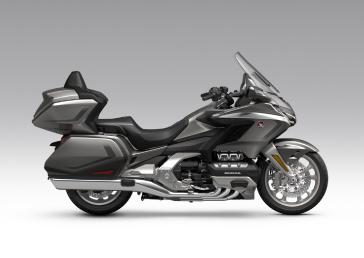
In the Gold Wing, Honda has created a dynamic, visually compact package that perfectly matches the motorcycle's performance-first pedigree, with the engine and exhaust shown proudly outside of the bike's fairings. The motorcycle is Honda to the core, with emphasis on a polished look and feel. Designed with comfortable ergonomics, effective heat management and refined aerodynamics, the Gold Wing is well-suited for long days on the open road.
Ergonomics
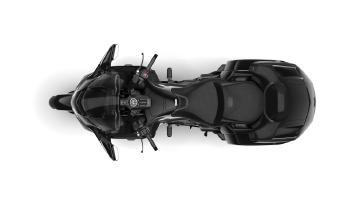
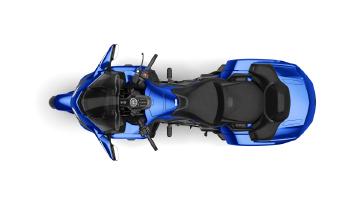
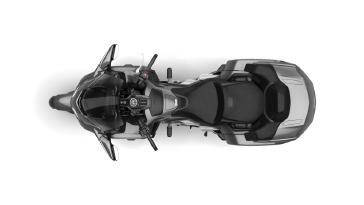
Performance should not give way to comfort, and the Gold Wing is proof that the two aren't mutually exclusive. A two-piece seat lets the rider comfortably enjoy operating the machine, while the passenger can also experience touring in absolute comfort. Hip support is designed for minimal restraint, allowing the operator to easily move about the saddle and enjoy the Gold Wing's spirited soul on twisting backroads. Likewise, the shape maximizes the potential for the rider to put his or her feet down at a stop, with a narrow junction between the frame and fuel tank. A premium, suede-like seat cover enhances feel and appearance.
The passenger is again considered heavily in the design; the passenger backrest angle is 24.5º for a relaxed riding position that reduces pressure on the passenger's hips, while the seat foam provides exceptional comfort on long rides.
Fairing
With the Gold Wing, Honda reimagined the meaning of air management, working to flow air smoothly over the rider and passenger rather than putting them in a windless, vacuum-like condition. Air-guiding ducts flow optimal amounts of air into the rider area, allowing a true motorcycling experience. Highly aerodynamic efficient fairings complement an impressive power-to-weight ratio to maximize fuel mileage.
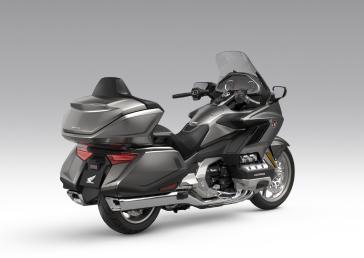
By making the side-mount radiator compact and high-performance, designers managed to minimize the front cowl width, while simultaneously earning a high degree of freedom in terms of styling design. In a move that was key to achieving an aggressive overall look, Honda engineers exposed the exhaust pipes, highlighting the Gold Wing's mechanical beauty.
The model's standout fuel efficiency enables the fuel tank to be relatively small (5.5 gallons), for optimal vehicle packaging and low weight.
Windscreen
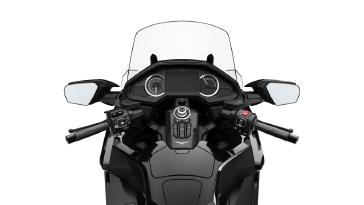
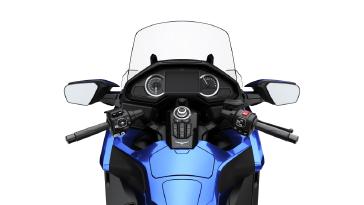
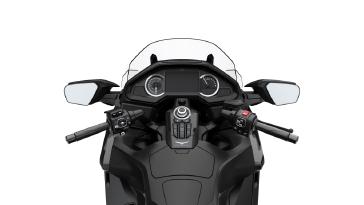
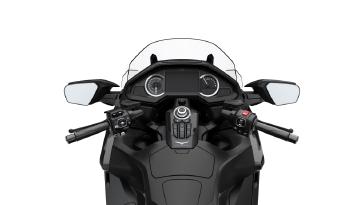
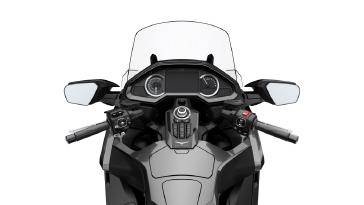
An electric windscreen provides the rider with a great degree of control over airflow. Manipulated via a switch on the left handlebar, its height and angle are adjusted in a stepless manner to achieve the ideal amount of airflow for city-street riding or higher-speed travel down the interstate. In this way, riders can always enjoy the most appropriate wind protection, based on the situation and personal preference.
Thanks to a short engine and linked, double-wishbone front-suspension system—which enabled engineers to bring the riding position forward, and thus bring the rider close to the windscreen—it was possible to minimize the size of the windscreen itself. The three Gold Wing Tour versions come with a tall windscreen, and the two standard Gold Wing versions come with a shorter windscreen. (The taller windscreen is available for the standard versions as a Honda Accessory.) Various accessory wind deflectors are also available.
Luggage
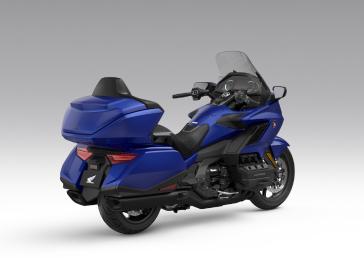
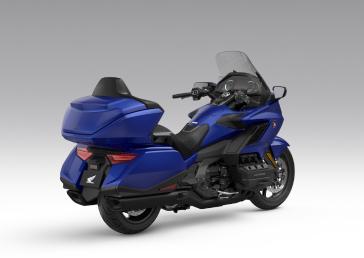
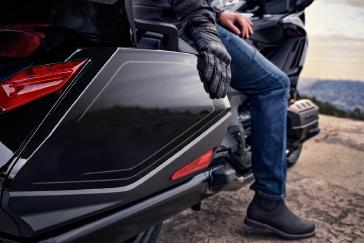
On the three Gold Wing Tour versions, the top trunk has a capacity of 61 liters, enough to fit an impressive amount of luggage or two XXL helmets, even when those helmets are outfitted with headsets. The right and left saddlebags each have a capacity of 30 liters. On the Tour versions, storage capacity is sufficient to accommodate supplies for two people traveling for three nights/four days. For smooth operating, the saddlebags and rear trunk use high-quality lid dampers.
(The rear box from Tour versions can be purchased as an accessory and installed on standard versions, in cases where those customers desire additional storage space.)
Lighting
LED technology is used for all lighting, with the multiple-lens front lights forming the “wing lines” and the multiple-lens taillight creating an image of high quality. LED front turn signals are built into the mirrors, while stylish, all-red LED rear signals are built into the same unit as the taillight and brake light. The signals are designed to cancel automatically after a turn is completed.
Meter / Controls
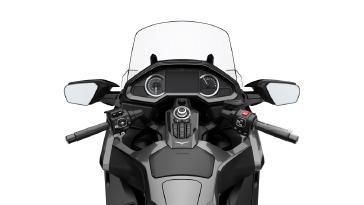
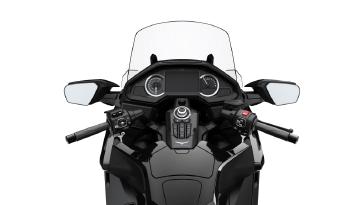
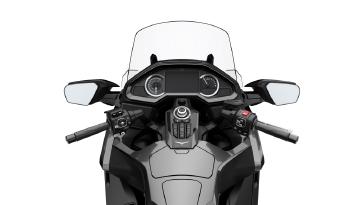
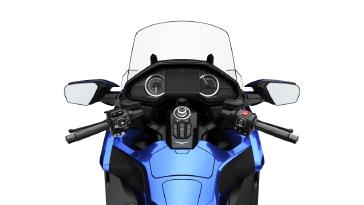
The Gold Wing's dash includes an analog speedometer on the left, an analog tachometer on the right, a seven-inch full-color thin film transistor (TFT) liquid-crystal display in the center, and a combination of smaller digital displays that provide pertinent information, including tire pressure, range and fuel level on the far left, as well as ride mode and gear position on the far right. Buttons on the center console allow easy navigation of information, while switches on the left handlebar enable the rider to easily navigate the main screen.
The Gold Wing platform features wireless Apple CarPlay and Android Auto capability, enabling owners to seamlessly enjoy app services such as navigation, music, phone calls and messaging.
For rich midrange audio, the Gold Wing platform features 45-watt speakers; Tour versions include two speakers at the front fairing and two at the trunk, while standard trim levels feature two speakers at the front. Volume-adjustment level is automatic for a quality experience in a wide range of riding conditions. The Gold Wing comes standard with an XM radio antenna, and the Airbag version's collision-judgment system is situated close to the center of gravity, for optimal mass centralization.
All Gold Wing versions are equipped with heated grips, and the Tour trim levels also feature heated seats as standard equipment.
ENGINE / DRIVETRAIN
Honda's iconic, liquid-cooled, horizontally opposed six-cylinder engine is the heart of the Gold Wing, designed to be compact, fuel efficient and versatile in varying riding situations. The engine configuration offers the benefits of a low center of gravity, minimal vibration and quiet running. It was also developed to be light and compact, through the design of its crankshaft and Unicam® valve train. The short engine configuration enables the engine and seating area to be positioned forward in the chassis, affecting weight bias to promote sporty handling. Available with a six-speed manual transmission or with Honda's highly advanced seven-speed automatic DCT, the engine offers strong performance and magic-carpet-ride smoothness.
The cylinder bore and stroke are both 73.0mm, for a total displacement of 1,833cc. The cylinder sleeves are aluminum, contributing to the low engine weight. For a compact overall package, the crankshaft is formed from a high-strength SCM440H steel-alloy material that enabled engineers to achieve a thin crank web and minimize the distance between cylinders, at 81mm. The crank pulser (which detects the engine speed and the piston positions, for controlling fuel injection and ignition timing) is positioned to the rear, allowing the crankshaft to be positioned forward. Together, these features result in an engine that is short at the front, placing vehicle weight and rider position forward.
The Unicam valve train, a design that has been proven in Honda's legendary CRF450R motocrosser, uses a finger-follower rocker-arm system on the intake side and roller rocker-arm system on the exhaust side. Doubly beneficial, this design enables elimination of the valve-lifter-support structure, resulting in weight minimization and a compact layout. The roller-rocker-arm system on the exhaust side also minimizes friction, contributing to good fuel efficiency. A molybdenum coating on the piston skirts has the same positive effects.
The engine uses four valves per cylinder in pent-roof-type combustion chambers for good combustion efficiency. The intake valves are 27mm, and the exhaust valves are 24mm. For added weight minimization, the camshaft is manufactured from FCD600M (a lightweight, high-strength material), and the water-cooling routes are simple. All this helps to create a package that is compact and performance-minded on the road, with a great power-to-weight ratio.
Starter
In another weight-minimizing measure, all Gold Wing versions feature an integrated starter generator system (ISG), which consolidates the generator and starter-motor functions into one component. This incorporation allows for elimination of the starter motor and starter-system wiring, which saves weight and reduces noise during starting.
Intake System
Intake efficiency was a key focus for enhancing throttle response and torque. The lightweight system uses a single 50mm throttle body and a thin 3mm intake manifold with minimized internal diameters. Intake-manifold volume and duct positioning were carefully tuned, and the duct shape creates a swirl effect that helps the engine draw evenly across the entire air filter. These refinements work together to improve response and torque, particularly at initial throttle openings.
Exhaust System
To create a pleasing exhaust note that is worthy of the Gold Wing, a structure was designed for the sequence leading from the exhaust pipe to the muffler, with an absence of fiberglass in the system ensuring an appropriately sporty sound quality.
Transmission
For transferring power to the rear wheel, the Gold Wing is available with a six-speed manual transmission or Honda's advanced seven-speed automatic Dual Clutch Transmission (DCT), each of which features technology for ease of use and a quiet, enjoyable riding experience.
DCT
In the world of powersports, Honda is a pioneer with dual-clutch transmission technology, having first offered it on the 2009 FourTrax Rancher multipurpose ATV, followed by the 2010 VFR1200F sport-touring motorcycle. Since then, the technology has been offered on Honda adventure bikes, cruisers, sport tourers, ATVs and side-by-sides. While similar systems can be found in some high-performance sports cars, Honda pioneered the use of DCT in the powersports world and has accumulated experience and improved the technology along the way. The introduction of the 2018 Gold Wing welcomed DCT to the touring category, and it was well-received, thanks in part to the fact that it enables riders to focus attention on riding, without concern of stalling. Since the introduction of DCT on the Gold Wing, a majority of customers choose it over the manual transmission.
DCT delivers consistent, rapid, seamless gear changes, and very quickly becomes second nature to use. It utilizes two clutches—one for startup and first, third and fifth gears, the other for second, fourth and sixth gears—with the main shaft for one clutch positioned inside that of the other. Each clutch is independently controlled by its own electro-hydraulic circuit. For a gear change to occur, the system pre-selects the target gear through the clutch not currently in use. The first clutch is then electronically disengaged as the second clutch simultaneously engages. As the twin clutches transfer drive from one gear to the next with minimal interruption to rear-wheel drive, gear-change shock and pitching of the machine are minimized, resulting in shifts that are not only smooth, but direct. The extra benefits of durability (as the gears are less likely to be damaged by missing a shift), low-stress urban riding and reduced rider fatigue add to the appeal of DCT.
In the case of the Gold Wing, the DCT also features Walking and Reverse modes, with creeping speed for situations like maneuvering the motorcycle around a parking space. In Walking mode, one clutch enables forward movement, and the other clutch enables rearward movement. In either direction, engine speed is controlled by the throttle-by-wire system, and clutch engagement is ideally modulated. Walking mode speeds are limited to 1.1 mph in forward direction and .75 mph in reverse direction, with the rider easily controlling the system through the + and – buttons on the left handlebar cluster. Engineers devised a special chain-and-gear system that utilizes DCT shafts for the reverse function, thereby eliminating the need for a traditional mechanism.
High-strength materials enabled engineers to minimize the face-width of each gear, contributing to a compact engine. In addition, this latest-generation DCT maximizes performance through damper rubbers that reduce shift noise and deliver a shift feel worthy of a flagship model. Dampers are affixed to both ends of the fork shaft, suppressing the noise that is generated when the edge face of the fork shaft (which supports the shift fork that moves the gears during shifts) strikes the engine case, a situation that occurs when energy is released during shifts. The master-arm damper works much the same, mitigating any sound created when the arm strikes the stopper pin that regulates its movement. Meanwhile, the DCT clutch-center spring damper—positioned between the clutch and the main shaft—absorbs torque and minimizes noise caused by the engagement between dogs and the clutch during shifts. Thanks to a good coordination between clutch control and the throttle-by-wire system, shift shock and shift time are both minimized, especially in Sport mode.
The lower gears are characterized by close ratios for a narrow change in engine speed and driving force when shifting gears. Meanwhile, the taller gears have a wider ratio for low engine speeds during highway cruising.
Standard Transmission
Gearbox technology and benefits are not limited to the DCT, as the six-speed manual transmission also features a cam damper between the clutch and transmission to minimize noise and shock, and to enhance durability. This gearbox enables low engine speeds when cruising at 60 mph, which creates a quiet overall riding experience. Each manual-transmission version of the Gold Wing is equipped with an assist and slipper clutch, to minimize clutch-operation load, as well as shift shock during downshifting. For the reverse mechanism, the electric starter motor is used.
ELECTRONIC CONTROLS
The Gold Wing is equipped with electronics for seamless performance, including a throttle-by-wire system that features multiple ride modes and convenient electronic rider aids.
Riding Modes
Riders can change between four riding modes, each with distinct settings that help tailor the riding character of the motorcycle for the specific conditions. The process of switching modes is completed when the rider totally closes the throttle.
The modes are:
- TOUR: This is the default riding mode, and it handles the most wide-ranging conditions. This setting achieves a good balance between the outstanding comfort that characterizes a touring motorcycle, and the Gold Wing's uniquely dynamic performance potential. The DCT versions respond to the rider's acceleration demands through automatic downshifting at the appropriate timing (according to the throttle position).
- SPORT: Enabling the rider to fully enjoy the Gold Wing's dynamic performance, Sport mode features powerful acceleration thanks to sharp responsiveness. With DCT versions, the automatic-shifting schedule enables the engine to climb to higher speeds. While combined braking bias is relatively unchanged in the other three modes, Sport mode applies comparatively more pressure to the rear brake when the front brake is applied.
- ECON: This mode gives expression to the engine's character when riding in a relaxed manner on roads in cities and suburbs. Through mild acceleration and deceleration characteristics, as well as the suspension's soft damping qualities, relaxed cruising is possible. In the DCT versions, shifts occur at lower engine speeds, also contributing to improved fuel efficiency.
- RAIN: This mode is intended for riding in low-grip situations such as on wet and/or dirty roads. This setting provides acceleration and deceleration characteristics that (compared to Econ mode) are milder in response to throttle input, with added torque control. With DCT versions, the shifts occur at low engine speeds.
HSTC
Designed to help the rider manage rear traction, Honda Selectable Torque Control calculates the slip ratio of the rear wheel by measuring the vehicle-speed signal of the non-contact ABS wheel-speed sensors. When slip is detected, the system steps in through adjustments to the throttle valve and fuel injection.
Hill Start Assist
Hill Start Assist makes it simpler to resume riding after stopping on an ascent. When HSA is activated in such situations, and the rider releases the brake, the ABS modulator generates hydraulic pressure on the rear-brake caliper; if the rider uses the throttle to resume forward motion within three seconds, the motorcycle will not roll backward. Throughout the entire process, an HSA indicator illuminates on the display.
Cruise Control
Ideally calibrated through the throttle-by-wire system, Honda's cruise control works to deftly manage a set speed in varying conditions, such as when traveling up a hill. For easy reference, the rider's set speed is clearly shown on the meter.
Smartphone Compatibility
All Gold Wing versions are compatible with Apple CarPlay, which enables the rider to access Apple Music and Maps, make phone calls and send messages, all through the bike's TFT display or by voice through Siri. Android Auto integration enables customers with Android 5.0 or later smartphones and the Android Auto app to seamlessly enjoy application services such as music, phone calls and messaging. Both Apple CarPlay and Android Auto can be used wirelessly.
Smart Key
To start the engine, the rider only needs to have the Smart Key in his or her possession and to turn the main switch knob to the right, then press the start switch. To stop the engine, the switch knob must be turned to the left. Owners can also lock the steering by turning the handlebars while simultaneously turning the switch knob one more position to the left. As an added feature, the main switch knob glows when the owner approaches the bike with the Smart Key. For security purposes, it is possible to turn the Smart Key off.
The Gold Wing is outfitted with Vehicle Viewfinder, meant for helping to locate the motorcycle (in large parking lots, for example). To activate, one must press and hold the Smart Key call button, which activates the motorcycle's hazard flashers and activates the horn.
Airbag
Honda was the first motorcycle manufacturer to fit a two-wheel model with an airbag, starting in 2006, and it continues that practice with the current Gold Wing Tour Airbag Automatic DCT, which comes equipped with a state-of-the-art airbag system. In the event of a frontal collision, the system slows the rider's momentum as he or she is thrown forward.
The system consists of an airbag module and a collision-judgment system, which operates via an acceleration sensor and main control unit. Thanks in part to information learned in collision tests and computer simulations completed at an all-weather omnidirectional collision-experiment facility, the system is designed to be lightweight, and it is positioned close to the center of gravity for optimum mass centralization.
CHASSIS / SUSPENSION
Offering the optimal balance between stability and maneuverability, the Gold Wing chassis is engineered for comfort on the open highway and precision on tight backroads, with an overall character that is smooth and confidence-inspiring.
Geometry
All members of the Gold Wing family have a wheelbase of 66.9 inches, a seat height of 29.3 inches, a ground clearance of 5.1 inches, while rake is 30.5 degrees. Curb weight—including all required fluids and a full tank of fuel—ranges from 806 pounds for the standard Gold Wing, to 856 pounds for the Gold Wing Tour Airbag Automatic DCT.
Frame
The twin-spar frame was designed with plate thickness carefully studied in specific areas to achieve ideal rigidity and flex characteristics. This was done with the help of calculations for stress on each area of the frame, a process that helped to minimize weight.
Mass centralization was achieved through a relatively short seat rail, with the rider and passenger placed forward. Maneuverability in all riding situations is impressive, thanks to the low center of gravity.
Swingarm
The single-sided swingarm has the driveshaft built in. It uses a pivot-area structure, with the arm secured to the frame only on the left side, while the function of the right pivot area is limited to supporting the structure. This arrangement affects the stress on the frame's swingarm pivot plates, giving engineers more freedom in the approach to frame rigidity, ultimately enhancing maneuverability. Needle bearings are used at the swingarm mounting points.
Brakes
The Gold Wing is outfitted with a pair of six-piston, radially mounted Nissin front-brake calipers and 320mm discs, an indicator of the model's sporty nature. The single rear brake rotor measures 316mm, and the caliper has three pistons.
The electronically controlled combined ABS optimally distributes braking force to the front and rear wheels. To minimize weight, the system is operated by a single small, light, circulation-type ABS modulator that is integrated with the brake ECU. The combined ABS settings are linked with the riding modes, to automatically adjust to braking characteristics ideal for the riding situation.
Wheels
The tires were specifically designed for the Gold Wing. The 200/55-R16 rear tire offers good stability at low speed, a move made possible by the motorcycle's impressive agility in other areas. The front tire measures 130/70-18.
Suspension
The Gold Wing platform's sporty character encourages riders to search for the next set of tight, twisting corners, and the suspension solutions are meant to help tackle these sections of road with confidence, while still providing unparalleled comfort on the highway. This task is managed through a unique double-wishbone front-suspension configuration and Pro-Link® rear-suspension design. Both suspension systems use Showa shock absorbers.
The Tour versions feature electric preload adjustment, for easy selection of the appropriate setting, depending on if a passenger and/or luggage are being carried. Also on the Tour versions, front and rear damping force are electronically adjusted, with a stepping motor moving the needle in each system to control the oil-flow rate and adjust damping force to mode-specific settings. These suspension settings are linked to the individual riding modes and do not change until a new riding mode is selected. There are four electric preload settings to choose from—in order from soft to stiff: Rider; Rider + Luggage; Rider + Passenger; Rider + Passenger + Luggage. The non-Tour versions have manually adjustable rear preload.
The Gold Wing's double-wishbone front-suspension system offers multiple benefits, the first being to minimize the shock transmitted to the handlebars. This is accomplished through a design that incorporates a pair of forked arms, eliminating any concern of friction between tubes, and minimizing the total shock transmitted from the road surface to the handlebars.
A second benefit of the double-wishbone front-suspension system is a minimization in inertial mass of the front-end components that are manipulated via the handlebars. As a result, Honda engineers were able to spec a stability-enhancing 66.9-inch wheelbase while simultaneously maximizing responsiveness and nimbleness, key to ease of use on city streets. The front-suspension system features bearings for all shaft bushings, further minimizing friction for both stroke and steering.
The double-wishbone front-suspension system contributes to a compact vehicle package, as the stroke trajectory of the suspension only needs minimal clearance between the front tire and the engine area. In turn, engineers were able to place the motorcycle's engine (and, subsequently, the rider position) forward. The result is an optimized load allocation, with a relatively high percentage of weight on the front wheel, contributing significantly to the Gold Wing's responsive, nimble handling and overall sporty attitude.
At the rear, the Showa shock absorber and Pro-Link system feature progressive reaction for a comfortable ride. Spherical joints at the top and bottom of the shock absorber help to cancel out torsion of the Pro-Arm® structure, further improving the ride.
Honda ACCESSORIES
More than 40 Honda Accessories are offered for the Gold Wing platform, enabling rider customization or to meet rider-specific needs.