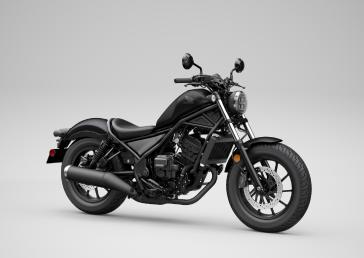
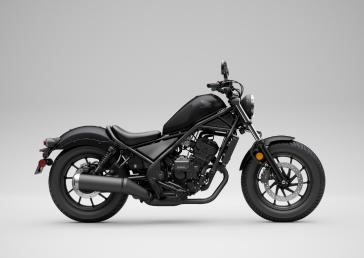
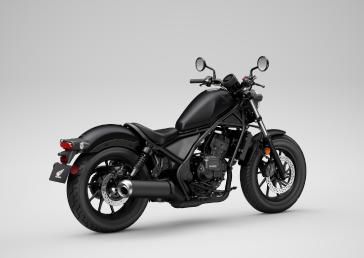
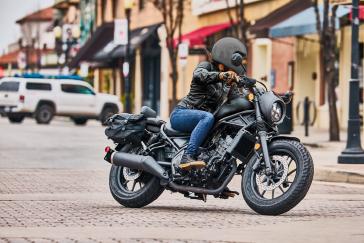
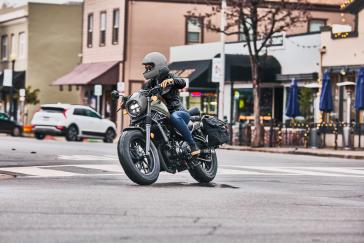
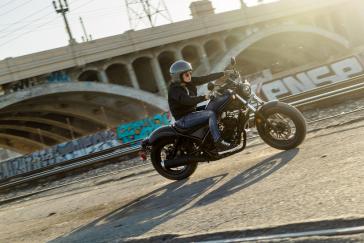
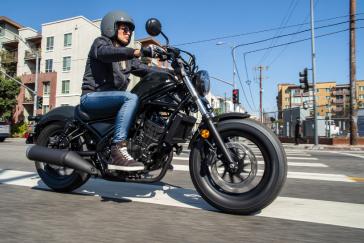
When it comes to introducing new riders to on-road motorcycling, few models can compete with Honda’s Rebel 300. Thanks to its unintimidating nature, low seat height, feathery overall weight, controllable power, fun style and affordable MSRP, this little cruiser has long served as an entry point for folks looking to dip a toe into the excitement of riding. Consequently, it makes sense that the Rebel 300 is a common choice for riding schools like the Motorcycle Safety Foundation’s Basic RiderCourse. For the 2026 model year, the popular model is even more approachable, as it comes with Honda E-Clutch technology, which is designed to make motorcycling even more enjoyable and exciting.
HISTORY
Honda first introduced the Rebel 250 in 1985, offering new riders an inexpensive, approachable entry point to motorcycling. Powered by a 234cc parallel-twin engine, the little cruiser was a favorite teaching platform among riding instructors.
Production continued off and on for over three decades, with several updates made along the way. For the 2017 model year, Honda completely revamped its smallest cruiser, switching to a 286cc single and renaming the model the Rebel 300. Also new were the chassis and styling, giving the model a hip, fun aesthetic and proving that riding an entry-level machine and being cool aren’t mutually exclusive.
The Rebel 300 received several updates for 2020, aimed at comfort (improved seat and suspension components), convenience (updated LCD meter and LED lighting) and performance (the addition of an assist/slipper clutch). The 2025 model received additional updates aimed at improving comfort, convenience and style, and for the 2026 model year, the Rebel 300 becomes the third Honda model (after the CB650R and CBR650R) to come with Honda E-Clutch technology.
NEW FOR 2026
- Honda E-Clutch technology is now standard on the Rebel 300.
DESIGN / STYLING
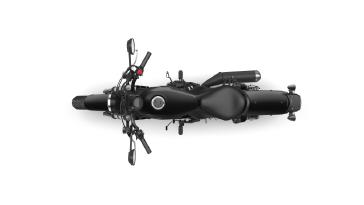
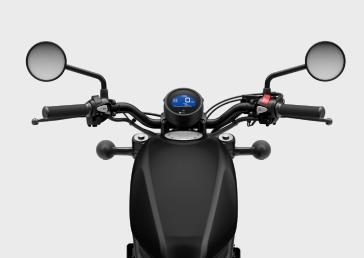
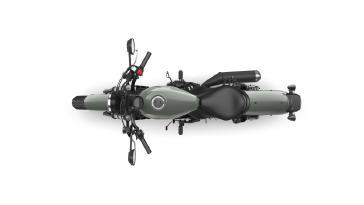
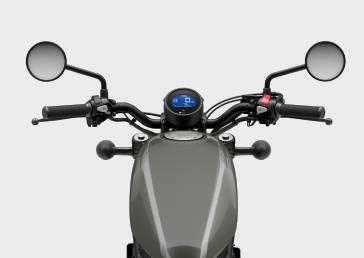
The Rebel 300 E-Clutch features a relaxed, neutral riding position that lets the rider’s feet drop straight down to the mid-mounted footpegs, with the arms gently outstretched to the tapered handlebar. The frame has a narrow shape, and a rear loop separates the seat from the stamped-metal rear fender.
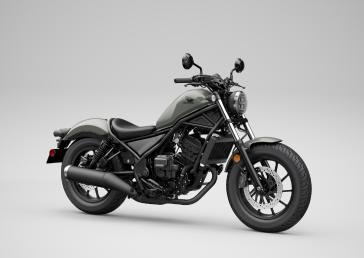
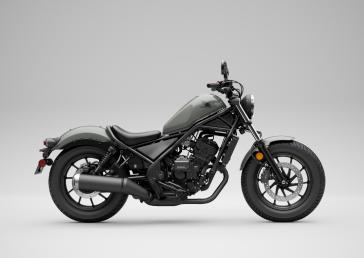
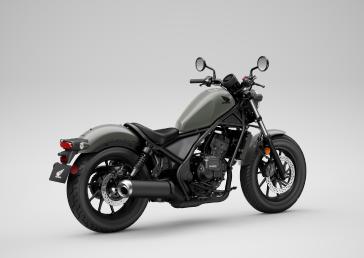
Blacked-out mechanical components give the bike a tough, minimalist look that is reinforced by the LED headlight, turn signals and taillight. The iconic, peanut-shaped fuel tank holds 3.0 gallons, and the front and rear fenders are color-matched for an attractive look. The raked front end and fat tires on large-diameter wheels result in stripped forms that express offbeat individuality from every angle. The ignition is housed below the left side of the fuel tank.
The LCD meter with gear-position indicator and fuel consumption provides pertinent information to the rider.
ENGINE / DRIVETRAIN
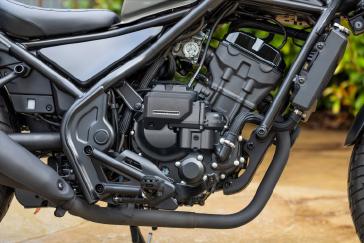
The Rebel 300 E-Clutch is powered by a peppy, liquid-cooled 286cc single-cylinder four-stroke engine with dual overhead cams and four valves. The bore and stroke dimensions are 76.0mm x 63.0mm, and the compression ratio is 10.7:1.
Induction is via programmed electronic fuel injection (PGM-FI), and the throttle body is 38mm. The specially designed muffler looks good and emits a pulsating exhaust note.
As before, the transmission has six speeds, although now it comes standard with Honda E-Clutch technology. An assist/slipper clutch results in reduced effort in stop-and-go situations and enhances controlled deceleration.
Honda E-Clutch
Honda E-Clutch takes elements of the technology and performance of quick-shifters, manually operated clutches and Honda’s Dual Clutch Transmission to create a unique blend of these proven approaches, opening a new aspect of the motorcycling experience for riders of varying types and experience levels. The clutch and transmission hardware are no different from a conventional motorcycle, and the compact system weighs less than four and a half pounds.
Honda E-Clutch simplifies gear changes by eliminating the need to use the clutch lever for upshifts or downshifts. Riders can simply tap the shift pedal for quick, consistent gear changes, enhancing the overall riding experience. The clutch lever is also not needed when starting from a stop or coming to a halt. Activating as soon as the engine starts, the system prevents stalling and manages these transitions smoothly—boosting rider confidence in stop-and-go urban traffic and on challenging inclines.
In addition to enjoyment and convenience, Honda E-Clutch brings ultimate flexibility, allowing riders to use the clutch lever manually at any time if they choose. When the clutch lever is used, Honda E-Clutch temporarily pauses, then automatically reactivates—after less than a second at higher engine speeds or after five seconds at lower engine speeds. When E-Clutch is paused, manual operation is indicated by a letter “M” on the instrument panel. The technology will also advise the rider to shift down (via a symbol on the instrument panel) if it detects that the motorcycle is in a high gear at a certain speed.
“Our Honda E-Clutch is designed to offer motorcyclists a new kind of experience that can make their riding even more fun and exciting,” said Junya Ono, Honda E-Clutch Large Project Leader. “It also adds peace of mind and comfort to town riding or the daily commute. We hope that many riders will try our new system to enjoy the unique mix of sportiness and flexibility it offers.”
CHASSIS / SUSPENSION
To support the Rebel 300’s low-slung look, its attractive tubular-steel frame holds the engine in three places and is designed to be as narrow as possible around the rider’s inseam. Trail is set at 4.3 inches, with a 28° rake, resulting in balanced, neutral steering. The seat height is 27.2 inches, ensuring that riders of any height feel confident when coming to a stop. The bike has an ample ground clearance of 5.9 inches, allowing for sporty lean angles.
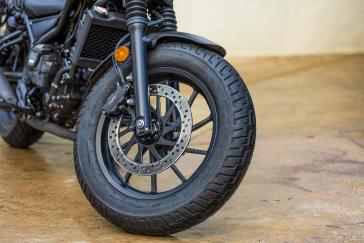
The 41mm fork stanchions are set wide at 9.1 inches apart, for rigidity, comfort and style, and the lower legs are blacked-out. The conventional telescopic fork also features buffing on the inner pipes, for smooth action. Front-wheel travel is 5.5 inches.
Dual conventional shock absorbers mount on each side to a blacked-out 45mm tubular swingarm and feature two-step preload adjusters. The shocks’ damper tubes use nitrogen gas to stabilize the damping force; rear-wheel travel is 3.7 inches.
Dunlop tires (size 130/90-16 front, 150/80-16 rear) are mounted to 16-inch cast-aluminum wheels, and stopping duties are handled by single hydraulic disc brakes front and rear, with 296mm and 240mm rotors, respectively. The Rebel 300 E-Clutch features ABS.