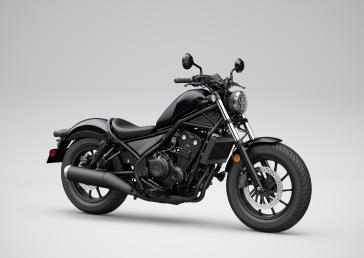
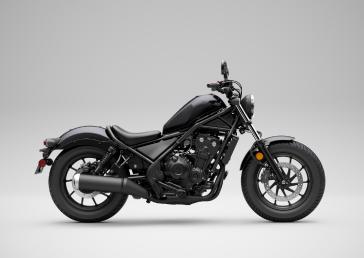
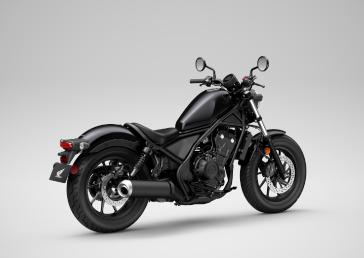
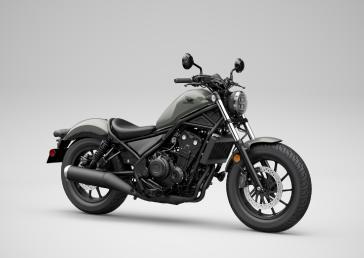
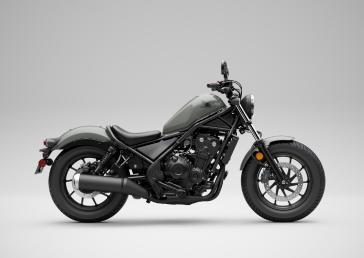
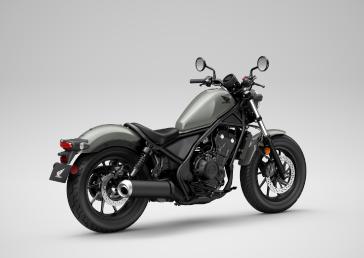
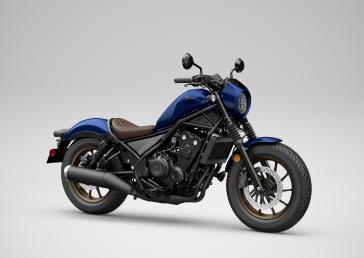
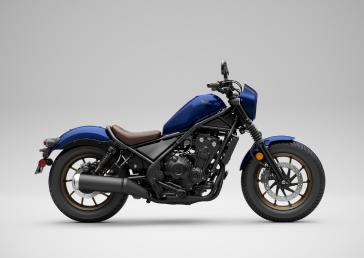
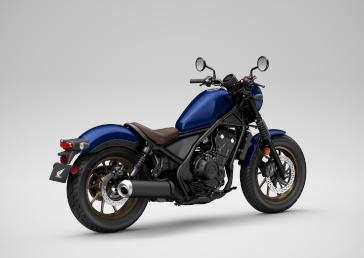
As the industry’s best-selling cruiser, the Rebel 500 has a proven record as a fun, approachable machine that offers comfort, performance and style. Nimble and light, it’s a great option for those getting started in motorcycling, those stepping up from a smaller bike or even for experienced riders seeking an affordable machine for getting around town in style. Available in a standard version and an SE trim level with select accessories factory-installed, the Rebel 500 promises to retain its popularity for years to come.
HISTORY
The bigger sibling of Honda’s Rebel 300, the Rebel 500 was introduced for the 2017 model year. Powered by a 471cc parallel-twin engine, the model featured “bobber” styling and a hip, fun aesthetic, proving that riding an entry-level machine and being cool aren’t mutually exclusive.
The midsize cruiser received several updates for 2020, aimed at comfort (improved seat and suspension components), convenience (updated LCD meter and LED lighting) and performance (the addition of an assist/slipper clutch). An SE version was added the following year, with several accessories preinstalled.
For 2025, Honda offered the Rebel 500 with additional updates aimed at improving comfort, convenience and style.
TRIM LEVELS
Honda’s midsize cruiser is offered in two different versions:
- Rebel 500: One of the most popular choices for new riders, Honda’s Rebel 500 is practical, approachable and just plain fun. ABS is standard for 2026.
- Rebel 500 SE: The SE stands for Special Edition, and this version comes with several handpicked accessories preinstalled at the factory, including a brown diamond-stitch seat, black fork boots and a color-matched headlight cowl. Like the standard version, the SE comes with ABS.
DESIGN / STYLING
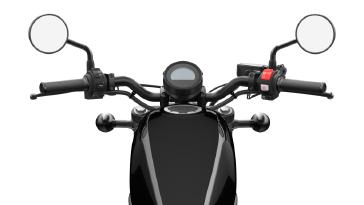
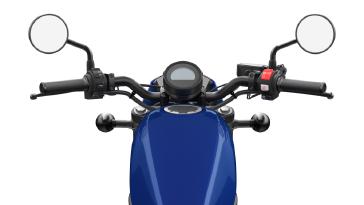
The Rebel 500 features a relaxed, neutral riding position that lets the rider’s feet drop straight down to the mid-mounted footpegs, with the arms gently outstretched to the tapered handlebar. The frame has a narrow shape, and a rear loop separates the seat from the stamped-metal rear fender.
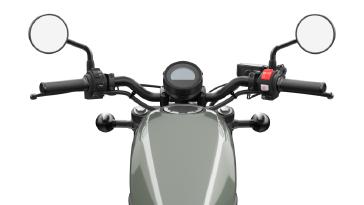
Blacked-out mechanical components give the bike a tough, minimalist look that is reinforced by the LED headlight, turn signals and taillight. The iconic, peanut-shaped fuel tank holds 3.0 gallons, and the front and rear fenders are color-matched for an attractive look. The raked front end and fat tires on large-diameter wheels result in stripped forms that express offbeat individuality from every angle. The ignition is housed below the left side of the fuel tank.
The LCD meter with gear-position indicator and fuel consumption provides pertinent information to the rider.
The SE version of the Rebel 500 features a brown diamond-stitch seat, black fork boots and a color-matched headlight cowl.
ENGINE / DRIVETRAIN
The Rebel 500 is powered by a 471cc, eight-valve, liquid-cooled, parallel-twin engine with strong bottom-end torque and a smooth, linear power delivery. The bore and stroke dimensions are 67.0mm and 66.8mm, and the compression ratio is 10.7:1.
Induction is via programmed electronic fuel injection (PGM-FI), and the throttle bodies are 34mm. The specially designed muffler looks good and emits a pulsating exhaust note.
The cylinder head uses roller rocker arms. Shim-type valve adjustment allows them to be light, for lower valve-spring load and reduced friction. A silent (SV Chain) cam chain has the surface of its pins treated with Vanadium to reduce friction, through its increased protection against dust. Inlet-valve diameter is 26.0mm, while exhaust-valve diameter is 21.5mm. Friction is reduced through the inclusion of striations on the piston skirt (a finish that increases surface area, introducing gaps in which oil can flow for better lubrication). An AB 1 salt bath process forms a protective oxidization membrane.
The crankshaft pins are phased at 180°, and a primary couple-balancer sits behind the cylinders, close to the bike’s center of gravity. The primary and balancer gears use scissor gears, reducing noise. The crank counterweight is specifically shaped for couple-balance, and its light weight allows the engine to spin freely, with low inertia.
The crankcases use centrifugally cast, thin-walled sleeves. Their internal design reduces the “pumping” losses that can occur with a 180° phased firing order. A deep oil sump holds 3.2 liters.
The six-speed gearbox is designed to offer smooth gear changes. An assist/slipper clutch allows for reduced effort in stop-and-go situations and enhances controlled deceleration.
CHASSIS / SUSPENSION
To support the Rebel 500’s low-slung look, its attractive tubular-steel frame holds the engine in three places and is designed to be as narrow as possible around the rider’s inseam. Trail is set at 4.3 inches, with 28° rake, resulting in balanced, neutral steering. The seat height is 27.2 inches to ensure riders of any height feel confident when coming to a stop. The bike has an ample ground clearance of 5.4 inches, allowing for sporty lean angles.
The 41mm fork stanchions are set wide at 9.1 inches apart, for rigidity, comfort and style, and the lower legs are blacked-out. The conventional telescopic fork features buffing on the inner pipes, for smooth action. Front-wheel travel is 5.5 inches.
Dual conventional shock absorbers mount on each side to a blacked-out 45mm tubular swingarm and feature two-step preload adjusters. The shocks’ damper tubes use nitrogen gas to stabilize damping force; rear-wheel travel is 3.7 inches
Dunlop tires (size 130/90-16 front, 150/80-16 rear) are mounted to 16-inch cast-aluminum wheels, and stopping duties are handled by single hydraulic disc brakes front and rear, with 296mm and 240mm rotors, respectively. Both versions of the Rebel 500 feature ABS.