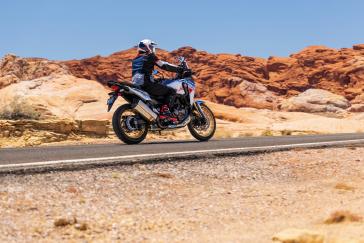
Few motorcycles embody the spirit of adventure like Honda's Africa Twin. Developed for riders who see the world as a network of possibilities rather than paved limits, the legendary model continues to deliver Honda's "True Adventure" philosophy through its rare balance of comfort, performance and capability. Whether carving through winding highways or exploring rugged dirt roads, the Africa Twin rewards curiosity with confidence—offering proven engineering, advanced technology and an unmistakable connection between rider and machine. Available in a nimble, off-road-focused standard version and the mileage-eating Adventure Sports ES trim level (both of which are offered with a manual transmission or Honda's high-tech automatic DCT), the Africa Twin remains the ultimate expression of go-anywhere freedom, backed by Honda's uncompromising reliability and global adventure heritage.
HISTORY
Since the 1988 introduction of the XRV650 in Europe, Honda's Africa Twin concept has come to represent the "True Adventure" ethos of ADV riding. That original version, based on the NXR750 and NXR800 factory racers that swept the Dakar Rally between 1986 and 1989, created a new market, grew into the XRV750 in 1990 and sold over 73,000 units before it was discontinued in 2001. The Africa Twin was reborn in 2016 with the CRF1000L, also offered in other markets including the U.S. In 2019, the standard Africa Twin was joined by the more touring-focused Adventure Sports version, with improved wind protection and greater fuel capacity. For 2020, the entire platform received a displacement boost to 1,084cc. Since then, these versions have become increasingly specialized for their respective realms, and that trend continued in 2024 with a series of updates. As was the case with the original, the modern Africa Twin has been a global hit with a wide array of adventure-riding enthusiasts.
TRIM LEVELS
- Africa Twin: Agile and maneuverable, the standard Africa Twin features a slim, compact shape and is great for sporty riding and off-road use, for which the 5.0-gallon fuel tank offers sufficient range while maintaining comfortable ergonomics. It has a 21-inch front wheel and an 18-inch rear, and front and rear suspension travel are 9.0 inches and 8.7 inches, respectively.
- Africa Twin DCT: Since its 2016 rebirth, the Africa Twin has been offered with Honda's advanced Dual Clutch Transmission, giving adventure riders the ability to choose between manual and automatic gear changes.
- Africa Twin Adventure Sports ES: The Adventure Sports ES version is ideal for putting in longer miles, with a 6.6-gallon tank for maximum range, and a front fairing that optimizes aerodynamics and wind protection. It has a 19-inch front wheel and less suspension travel compared to the Africa Twin (8.3 inches and 7.9 inches front and rear), for a low seat height and center of gravity, enhancing on-road handling performance. The Adventure Sports version also boasts Showa Electronically Equipped Ride Adjustment (EERA™), with suspension that automatically adjusts to conditions.
- Africa Twin Adventure Sports ES DCT: Like the standard Africa Twin, the Adventure Sports ES is available with Honda's DCT, which is a particularly great option for long-distance touring.
DESIGN / STYLING
The Africa Twin platform is offered in two basic configurations, each with a different focus—the sporty, off-road-ready standard version and the long-haul Adventure Sports ES version. Both are extremely versatile and are cover a wide range of riding applications. On all Africa Twin trim levels, the seat foam features optimized density to minimize long-distance riding fatigue, and tool-free seat-height adjustment enables high and low positions (an accessory Low Seat is also available). All trim levels feature a five-position adjustable windscreen, allowing riders to adapt to changing conditions.
Both the standard and Adventure Sports Africa Twins are available with either a standard gearbox or Honda's DCT, and both come with tubeless tires. Curb weight for the Adventure Sports ES is 535 pounds with a full tank of fuel, while the standard version weighs 510 pounds. DCT adds 24 and 25 pounds, respectively.
Lighting
The Adventure Sports ES versions of the Africa Twin has three-stage cornering lighting for optimal illumination depending on the corner type. Interpreting information from the IMU to determine the motorcycle's lean angle, the system provides auxiliary illumination from a pair of lights below the headlights; the greater the lean angle, the more light is spread toward the inside of the corner.
Meter / Controls
All trim levels within the Africa Twin platform feature a meter with a bright, 6.5-inch thin-film transistor (TFT) LCD touch panel that simplifies viewing, allowing the rider to understand and manage a plethora of data while concentrating on riding. Users can select from three screen-display arrangements and background colors, depending on personal preference.
The meter is compatible with Apple CarPlay® and Android Auto™, and it can be connected to smartphones or headsets via Bluetooth (check state laws for legality). By connecting an Apple or Android smart phone via a USB cable, riders and passengers can issue voice-control commands via a headset microphone, to use the phone or compatible apps.
A secondary, LCD screen below the main display relays important information for easy viewing when the primary screen is used for other functions, like Apple CarPlay and Android Auto.
ENGINE / DRIVETRAIN
All versions within the Africa Twin platform are powered by a water-cooled, single-overhead-cam, eight-valve, parallel-twin engine. For good touring capability, displacement is 1,084cc, achieved via 92.0 and 81.5mm bore and stroke figures. The cylinder sleeves are aluminum, helping to minimize weight. The 270° phased crankshaft and uneven firing interval create the engine's distinctive throb and feel for rear-wheel traction. The 46mm throttle body's injector angle delivers a direct spray into the twin-spark combustion chambers.
The crankcases are split vertically, and the water pump is housed within the clutch casing, with a thermostat integrated into the cylinder head. The water pump and oil pump are driven by the engine's balancer shafts. These features contribute to the engine being compact and short, and they help optimize ground clearance—a crucial element for off-road performance.
Honda's SOHC Unicam® valve train is a feature of the CRF450R motocrosser, and the low-set position of the cast camshaft contributes to the compact nature of the cylinder head. The engine uses a semi-dry sump and lower-crankcase oil storage, allowing a shallow pan depth and reducing overall engine height. Because the pressure-fed pump is located within the oil tank, there is no need for a pressure-feed passage, again saving weight and space.
Exhaust System
The muffler features a single inlet and dual outlets, with an exhaust-control valve (ECV—similar to that on the CBR1000RR sport bike) located in the main pipe, just downstream of the junction. The exhaust valve closes off the larger pipe at low rpm for a pulsating feel, but opens at high rpm so that gases exit through both pipes, for improved output.
The dual catalytic converters are compact, which is possible because generation of a swirl-flow enables the exhaust gases to be evenly applied to those catalyzers' surfaces. The result is not only minimal power loss, but efficient exhaust-gas purification. The catalytic converters are positioned close to the center of gravity, contributing to good handling feel through the centralization of mass.
Lean-air/fuel sensors (LAFs) constantly monitor the combustion status of each cylinder and apply appropriate fine-combustion control, thereby achieving excellent emission performance.
Dual Clutch Transmission
In the world of powersports, Honda is a pioneer with DCT, having first offered it on the 2009 FourTrax Rancher multipurpose ATV, followed by the 2010 VFR1200F sport-touring motorcycle. Since then, the technology has been offered on Honda touring machines, cruisers and side-by-sides. While similar systems can be found in high-performance sports cars, Honda pioneered the use of DCT in the powersports world and has accumulated experience and improved the technology along the way. The 2016 reintroduction of the Africa Twin welcomed DCT to the adventure category, and it was well-received, in part because it enables riders to focus more attention on line selection and throttle control during off-road riding, without concern of stalling. Globally, approximately half of Africa Twin customers choose DCT versions (just over 40% in the U.S.).
DCT delivers consistent, rapid, seamless gear changes, and very quickly becomes second nature to use. It utilizes two clutches—one for startup and first, third and fifth gears, the other for second, fourth and sixth gears, with the main shaft for one clutch located inside that of the other. Each clutch is independently controlled by its own electro-hydraulic circuit. For a gear change to occur, the system pre-selects the target gear through the clutch not currently in use. The first clutch is then electronically disengaged as the second clutch simultaneously engages. As the twin clutches transfer drive from one gear to the next with minimal interruption to rear-wheel drive, gear-change shock and pitching of the machine are minimized, resulting in shifts that are not only smooth, but direct. The extra benefits of durability (as the gears are less likely to be damaged by missing a shift), low-stress urban riding and reduced rider fatigue add to the appeal of DCT.
In the Africa Twin platform, Honda's advanced automatic DCT technology benefits from the IMU, which allows cornering detection for optimized shift timing.
With DCT on the Africa Twin, three modes of gear-change operation are available:
- AT D ("Drive"): An automatic setting that is ideal for daily city and highway riding, when comfort and optimum fuel efficiency are prioritized.
- AT S ("Sport"): An automatic setting that is suited for sportier riding, as the ECU lets the engine rev a little higher before shifting up, and shifts down sooner when decelerating, for extra engine braking. There are three sub-settings within S mode, from the more "torquey," moderately sporty Level 1, to the sportiest Level 3.
- MT ("Manual"): A setting that gives full manual control, allowing the rider to change gears via handlebar triggers.
In the two automatic modes, immediate manual intervention is possible; the rider simply selects the required gear using the up and down shift triggers on the left side of the handlebar. After an appropriate interval (depending on throttle angle, vehicle speed and gear position), the DCT seamlessly reverts to automatic mode.
A G-Switch enables the rider to select the riding feel, depending on factors like surface conditions. With the G-Switch turned off, the clutches are allowed to "slip" against engine torque, for a smooth reaction to throttle operation; benefits include increased assurance during situations like low-speed U-turns, for example, and mitigated fatigue during long-distance riding. On the other hand, turning on the G-Switch results in reduced clutch "slip," allowing the rider to more readily slide the rear tire via throttle input, to maneuver the bike.
Further functionality with the DCT system comes in the form of incline detection, which adapts the gear-shift pattern depending on the grade of an uphill.
Manual-transmission versions of the Africa Twin are offered for customers who still enjoy making gear selections themselves. The six-speed manual gearbox uses the same shift-cam design as found on the CRF450R, to ensure positive gear changes. The aluminum clutch center and pressure plate use "assist" cams to ease shifting (with light lever feel), and they feature "slipper" cams for deceleration and downshifting.
An accessory quick-shifter is available, to eliminate the need to use the clutch or close the throttle during gear changes. When the shift pedal is operated, the shift rod's stroke sensor converts that movement into electronic signals, and the system considers ECU information such as vehicle speed, engine acceleration, deceleration condition and gear position, in order to determine timing of the fuel-injection interruption, the throttle-valve opening and the ignition timing, thereby lowering the drive load on the transmission gear for shifting.
ELECTRONIC CONTROLS
Throttle-by-wire is used on the Africa Twin platform, featuring a Bosch MM7.10 IMU that performs real-time six-axis measurement (angle and rate for roll, pitch and yaw) to identify the motorcycle's position and movement. The system maximizes the accuracy of various controls and systems, including shifting on DCT trims, Honda Selectable Torque Control (HSTC) and braking, as well as suspension and lighting on Adventure Sports ES trims. Cruise control is standard on all versions, while the Adventure Sports ES versions add heated grips and a power outlet near the front fairing.
Riding Modes
Riders can change between six riding modes, each of which respond to a wide variety of situations, providing a sense of assurance and enhancing enjoyment.
The modes are:
- TOUR: A preset mode for long-distance riding with luggage, giving powerful acceleration.
- URBAN: A preset mode dealing with a wide variety of riding needs.
- GRAVEL: A preset mode for comfortable riding on poor surface conditions, suitable for riding on flat dirt roads.
- OFF-ROAD: A preset mode for riding on unpaved surfaces.
- USER 1: A customize-able mode that a rider can set to his or her preference.
- USER 2: An alternative customize-able mode that the rider can set.
Each riding mode adjusts power output; level of engine braking; suspension damping on ES trims (hard/standard/soft); and front ABS (on-road/off-road). In OFF-ROAD, rear ABS can be adjusted to active or inactive. In the two USER modes, the rider can fine-tune the settings within each of those areas; many may choose to set up USER 1 mode with their favorite on-road settings and USER 2 with their preferred off-road settings.
HSTC is not linked to riding modes.
HSTC / Wheelie Control
The Africa Twin's Honda Selectable Torque Control utilizes the IMU, enabling smooth slide control and wheelie control, assisting riders of widely ranging skill levels by maximizing acceleration performance.
With HSTC, the ECU uses data from sensors on the front and rear wheels to identify different scenarios. When the rear wheel accelerates suddenly but the front wheel doesn't, the system infers that rear-tire spin is occurring. To rectify the situation, engine torque is reduced based on the amount of slip, the slip change rate, and the motorcycle's rolling and yawing behavior, helping to correct the slide. Riders can select from seven levels of slip control that cover a broad range, with Level 1 intervening less and Level 7 intervening more. Slip-control intervention can be switched off, and three levels of engine braking are available.
When the system detects the rear wheel accelerating while the front wheel decelerates, a wheelie is the diagnosis, so engine torque is reduced based on the motorcycle's pitch angle, helping to bring the front wheel back down. There are three levels of wheelie control, with Level 1 allowing intentional front-wheel lift and Level 3 making it much harder to wheelie. As with slide control, wheelie control can be switched off.
Note that HSTC does not eliminate the possibility of slides or wheelies; rather, it is an auxiliary system to assist the rider during acceleration operations. As is the case with models without HSTC, the Africa Twin will not handle unreasonable operations.
Battery
A lightweight, compact Eliiy Power lithium-ion battery helps minimize weight and centralize mass. This battery has minimal self-discharge, and Honda tests have shown it to offer greater longevity than a comparable lead-acid unit, both in terms of life and the ability to retain a charge.
CHASSIS / SUSPENSION
All Africa Twin versions use a steel semi-double-cradle frame, with optimized rigidity/flex characteristics for challenging situations like riding with luggage, riding two-up, or off-road riding. For example, rigidity around the steering head has been optimized to enhance front-end feel and grip, and the main spars are optimized to enhance longitudinal rigidity for good handling under braking. The frame's pivot plates are produced in high-strength 600MPa steel. The rear cross pipe, which connects the left and right pivot plates in the upper area, is positioned in line with the shock stroke, resulting in a direct transmittal of surface information to the frame, for good rear-wheel feel.
In addition, the rear subframe is separate and constructed of aluminum, minimizing weight while retaining the ability to carry luggage. The seat rails are narrow at the front, maximizing ease of movement during stand-up riding and allowing the rider's legs to reach the ground more easily when stopped.
Geometry
Overall length for the Africa Twin version is 91.7 inches (90.7 inches for the Adventure Sports ES version). Standard versions have a wheelbase of 62.0 inches, 61.8 inches for the Adventure Sports ES versions. The standard versions have a trail of 4.4 inches, while trail is 4.2 inches for the Adventure Sports ES versions; rake is 27.5 degrees for all four versions. The seat height is 34.3 inches for the standard versions (33.5 inches with the seat in the low position; for the Adventure Sports ES versions, seat height is 33.7 inches (32.9 inches in the low position). The standard Africa Twin versions boast 9.8 inches of ground clearance, enhancing off-road performance. The Africa Twin Adventure Sports ES versions feature 8.7 inches of ground clearance, allowing for a lower center of gravity and optimum on-road handling. With a full fuel tank and all required fluids, curb weights range from 510 pounds for the manual-transmission standard version to 559 pounds for the Adventure Sports ES DCT version.
Suspension
The standard and Adventure Sports versions of the Africa Twin feature suspension packages that are suited to their intended ride experience. Standard versions have 9.1 and 8.7 inches of front and rear wheel travel, respectively. The long-travel Showa suspension offers off-road capability and plenty of clearance for navigating technical terrain. The Adventure Sports ES versions have 8.3 and 7.9 inches of travel, complementing the 19-inch front wheel, lowering the center-of-gravity and maximizing low-speed maneuverability and front-end grip.
The Africa Twin Adventure Sports ES versions also feature Showa Electronically Equipped Ride Adjustment. This high-tech system adjusts the damping level based on information from three sources: bike speed (from the ECU), the bike's stance and attitude (from the Inertial Measurement Unit) and the fork behavior (from the stroke sensor). Once these calculations are made, the Suspension Control Unit adjusts suspension damping within a mere 15 milliseconds (0.015 seconds).
The system's flexibility means that damping adjustment can be programmed to change as the vehicle speed changes—allowing firmer damping at higher speeds, for example. In addition, it can adapt to specific circumstances such as preparing the suspension for landing from a jump or reducing dive under hard braking.
Showa EERA allows the rider to select between low-speed ride comfort, high-speed stability, sporting on-road performance and off-road response, at a touch of the screen.
With EERA, five suspension modes are available, each with different preload and damping settings:
- HARD: A preset mode with high damping forces for both high and low suspension-stroke speeds—achieving ride stability suitable even for riding two-up with luggage.
- MEDIUM: A preset mode with intermediate damping forces, between HARD and SOFT—suitable in a wide variety of circumstances.
- SOFT: A preset mode with soft damping characteristics for both high and low suspension-stroke speeds—achieving ride comfort and stability even on rough terrain.
- OFF-ROAD: A preset mode with progressive front-suspension characteristics (with damping force rising gradually between low and high stroke-speed), as well as rear-suspension characteristics with a damping force that is between SOFT and MID.
- USER: A customize-able mode that allows fine damping adjustments front and rear, along with 24 points of rear-spring preload, to meet rider preference.
The first four suspension modes are linked to the various riding modes, whereas the USER riding mode allows custom adjustment of the USER suspension mode.
Front and rear suspension on the standard Africa Twin versions is also fully adjustable, including preload, compression damping and rebound damping, with tuning changes accomplished via traditional dials and knobs.
Regarding suspension hardware, all Africa Twin versions feature a 45mm cartridge-type inverted Showa fork, and settings deliver on-road comfort and off-road performance. The top triple clamp is cast aluminum, while the bottom is forged.
The Pro-Link® rear-suspension system offers comfort across changing terrain. The shock is centered. A spherical, solid pillow-ball mount is used at the top of the shock to minimize deflection and help achieve a precise feel in varying conditions. The aluminum swingarm, based on that of the CRF450R motocrosser, is extremely rigid despite being quite light.
Wheels
Given their off-road focus, the standard Africa Twin versions feature a front-wheel size of 21 inches (90/90-21 tire), to roll freely over rugged terrain. The Adventure Sports ES versions have a 19-inch front wheel (110/80-19 tire) that lowers center of gravity and provides a larger contact patch for superior performance in an on-road application. Rear-wheel size for all Africa Twin versions is 18 inches (150/70R-18).
Brakes
Both Africa Twin versions have ABS, and advanced technologies enhance braking performance and rider confidence in varying conditions. Separate modes for on-road and off-road work together with the riding modes, allowing application-specific braking performance.
In addition, the system can adapt during trail braking: When the IMU detects a lean angle (indicating that a cornering maneuver is being executed), and the wheel sensors detect deceleration (indicating that the rider is braking), the system closely monitors both wheels' slip rates and makes necessary adjustments in braking pressure. During sudden braking, ABS reads IMU information to detect rear-wheel lift and precisely controls braking pressure to suppress that trend for improved control and confidence.
Note that ABS is an auxiliary system to assist the rider for braking operations. As is the case with standard braking systems, ABS requires adequate deceleration before corners, for example.
The Africa Twin's rear ABS can be switched off when the rider prefers separate front and rear braking performance, for example to brake-slide the rear wheel for off-road cornering.
As for braking hardware, compact two-piece, radial-mount, four-piston calipers work dual 310mm petal-style floating rotors through sintered pads and serve up consistent stopping power and feel, on-road or off-road. The rear rotor has a diameter of 256mm and also features a petal design.
ACCESSORIES
The Africa Twin is a versatile platform, and Honda's wide range of accessories is designed to adapt the motorcycle to the variety of ride experiences that customers seek out. The growing line of Honda Accessories includes paniers, engine guards, hand guards, low seats, enduro footpegs, a centerstand and more.