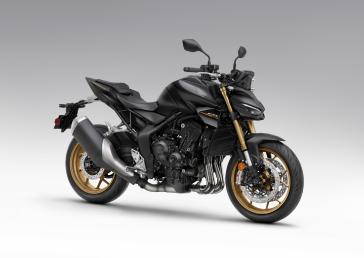
Honda's CB1000 Hornet SP channels decades of naked-bike heritage into a bold, modern performance statement. Delivering liter-class power in a streetfighter package, this premium Hornet model combines precision engineering and a raw street presence. The CBR1000RR-derived engine, high-spec components and aggressive stance make it equally at home slicing through canyon roads and ruling city streets. True to the Hornet name, the model is a perfect mix of refinement and rebellion—Honda's vision of performance stripped to a pure form.
HISTORY
Honda's Hornet aesthetic has played a big role in the international popularity of naked bikes over the past three decades. First up was technically the 1996 CB250 Hornet, but that little machine was largely unknown outside of Asia. Two years later, the CB600F Hornet was offered in Europe and other markets, where it was extremely popular, even inspiring the U.K.'s Hornet Cup spec road-race series. That model eventually reached the U.S. market in 2004, but because the Hornet name was owned by AMC/Chrysler, it was known here as the 599. Meanwhile, it had been joined in 2002 by the original open-class Hornet—the CB900F Hornet. Arguably based on a 1994 design-study collaboration between American Honda R&D and Cycle World, that model was marketed to U.S. customers as the 919.
The 919 and 599 were replaced in the U.S. in 2007 and 2013, respectively, and the Hornet name also disappeared overseas until the 2023 European introduction of the CB750 Hornet. That model was updated for the 2025 model year, when it and the CB1000 Hornet SP were brought to the U.S.
DESIGN / STYLING
Designed in Japan, the CB1000 Hornet SP's transformative looks are driven by two words: aggressive and pure. With the design team blending a sensual dynamism with balance of mass, the model's stripped-back style is an expression of non-decorative aggression.
The handlebar has a tapered, steel design. Led by the super-compact dual-projector headlights, the signature, 4.5-gallon fuel tank is broad-shouldered up front but tapers radically to the rear, giving the impression of wings folded forward. That theme continues at the back, where the minimalist seat unit and sharply pointed tail section create a narrow waistline and distinctive “stinger” silhouette. A color-matched seat cowl is available as an accessory, further enhancing the bike's sporty profile.
The subtly blacked-out frame is also used as a design feature; it and the trellis-style rear subframe underpin the lines. The engine and swingarm are also finished in black. All lighting is LED.
Meter / Controls
The 5-inch full-color TFT screen uses optical bonding to maximize visibility in bright sunlight. By sealing the gap between the cover glass and TFT screen with resin, glare is reduced, and visibility is optimized. The display is customizable between “Bar,” “Circle” and “Simple” patterns.
Honda RoadSync allows iOS/Android smartphone connectivity, and operation is via a simple, easy-to-use, backlit four-way toggle-switch on the left handlebar. This allows straightforward, on-screen turn-by-turn navigation, as well as the option (via a Bluetooth helmet headset) for the rider to make calls or listen to music. Owners need simply download the Honda RoadSync app from either the App Store or the Play Store and connect to the CB1000 Hornet SP.
ENGINE / DRIVETRAIN
Sourced from the 2017 CBR1000RR, the 1,000cc, DOHC four-cylinder engine is tuned to deliver a heavyweight punch in the low- to midrange, along with an exhilarating rush of power delivery at higher rpm, all the way to the redline. It offers performance and throttle response that work smoothly around town and on the open road.
A variety of detail work was done to tune the engine's character and delivery. Intake and exhaust valve lift and timing were developed to pump efficiently across the rev range. The intake-valve material is steel, and the shape of the lightweight, die-cast pistons was optimized for strength and durability. The ACG cover is aluminum, as is the oil pan.
The transmission is matched to the CBR1000RR's heart, with gears two through five optimized for acceleration (to match the engine's all-around drive), while sixth gear enables relaxed highway cruising. An assist/slipper clutch reduces lever effort, while also helping manage rear-wheel hop under hard, rapid downshifts and braking. The three-level adjustable quick shifter provides full-throttle, clutch-less upshifts, as well as clutch-less downshifting with auto-blip function.
The bore and stroke dimensions are 76.0mm x 55.1mm, and compression ratio is 11.7:1. A 44mm throttle body feeds the air/fuel mixture into large-diameter inlet ports and carefully shaped combustion chambers. The exhaust has a 4-2-1 design and contributes to the model's midrange muscle and light weight.
ELECTRONIC CONTROLS
Throttle by wire (TBW) on the CB1000 Hornet SP allows the rider maximum control over the powerful engine.
Riding Modes
The CB1000 Hornet SP's system offers five riding modes, divided into preset and customizable options. The three preset modes—designed for different riding conditions—automatically adjust the behavior of the motorcycle by selecting specific combinations of Power (P), Engine Brake (EB) and Honda Selectable Torque Control (HSTC, with integrated Wheelie Control).
For riders who prefer to fine-tune their setup, two USER modes allow full customization of these same parameters. Each of the adjustable functions offers three levels, and HSTC can also be switched off entirely.
The modes are:
- SPORT: A preset mode with the highest Power delivery and lowest levels of EB and HSTC, for maximum performance through all six gears, maximum torque and power at all throttle positions, and minor intervention from HSTC.
- STANDARD: A preset mode that uses the middle setting for Power, HSTC and EB. It softens the punch a little out of first and second gears and uses a power delivery just below that of SPORT mode, with reduced torque at partial throttle openings.
- RAIN: A preset mode that employs the lowest Power setting, for the least-aggressive power delivery, medium EB and high HSTC. The lower levels of power and torque delivery are focused on the first three gears.
- USER 1: A customizable mode that allows the rider to choose between the settings for each parameter, and to save the setting for future use.
- USER 2: An alternative customizable mode that the rider can set.
Selection is managed via a four-way selectable switch on the left handlebar, along with the TFT screen.
CHASSIS / SUSPENSION
The riding position is pure streetfighter, with a sporty footpeg location and a handlebar position that is up and back, resulting in a rider triangle that's still sporty, but with a relatively upright upper-body position. To support responsive handling, key components are positioned to centralize mass. The frame holds the engine close to the bike's center, while the shock absorber and battery are also packaged tightly inboard. The airbox also sits above the cylinder head rather than behind it, contributing to a compact layout.
Geometry
Rake and trail are 25° and 3.9 inches, and wheelbase is 57.3 inches. Weight distribution is 50.9% and 49.1% front and rear, respectively. Curb weight is 465 pounds including all standard equipment, required fluids and a full tank of fuel. with a seat height of 31.9 inches,
Frame / Swingarm
The frame is a one-piece steel twin-spar unit that has been designed to complement the engine and (through a narrow pivot point) deliver the classic slim-waisted naked-bike feel, as well as good torsional rigidity, for sharp turn-in and side-to-side handling agility. Rear engine mounting, along with carefully shaped front mounting plates, minimize vibration and optimize feel.
The rear subframe uses a trellis design that is light and looks great. The cast-aluminum, 24.4-inch-long swingarm provides tuned rigidity balance for optimum grip and feel.
Suspension
The Showa 41mm Separate Function Fork Big Piston inverted fork (SFF-BP) is adjustable for spring preload and rebound/compression damping. The Öhlins TTX36 shock absorber operates through Pro-Link and is adjustable for preload via a hydraulic knob; compression and rebound damping are fully adjustable.
Brakes
A radial master cylinder operates dual, radial-mount Brembo Stylema four-piston calipers that grip 310mm floating discs. The single-piston rear Nissin caliper grips a 240mm disc.
Wheels
Highlighting the model's sporty aspirations, the, lightweight, cast-aluminum wheels have a five-Y-spoke design and are inspired by the CBR1000RR-R Fireblade SP. The front and rear tires are sized 120/70-ZR17 and 180/55-ZR17, respectively.
Honda ACCESSORIES
A range of Honda Accessories are available for the CB1000 Hornet SP, including heated grips, Alcantara rider and passenger seats, a radiator grill, a tank bag, rear seat bag and more.