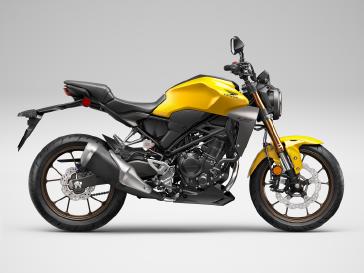
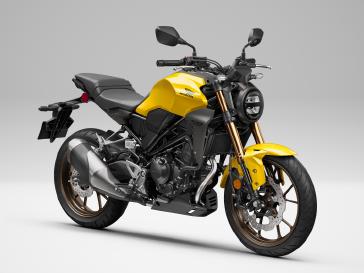
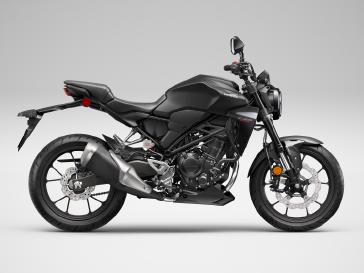
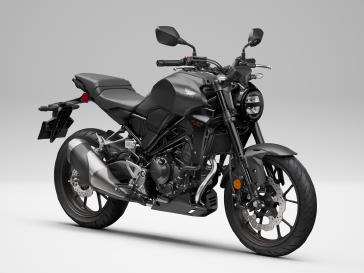
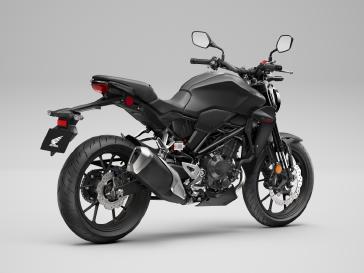
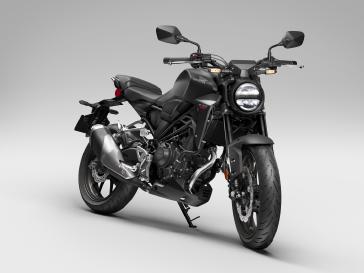
Delivering pure riding enjoyment through minimalist design and responsive performance, Honda's CB300R proves that less can be more. Ideal for new and returning riders who prioritize value, approachability, style and performance, this naked bike pairs Honda's Neo Sports Café aesthetic with lightweight agility and real-world versatility. Simple, refined and confident, the CB300R captures the essence of motorcycling in its most elemental form.
HISTORY
The CB300F naked bike was introduced for the 2015 model year, joining the full-fairing CBR300R sport bike in Honda's small-displacement, user-friendly on-road lineup. For 2019, the model was replaced by the CB300R, which shared the same "Neo Sports Café" aesthetic as the CB1000. Since then, it has proven to be a popular choice among new riders, even making frequent appearances in learn-to-ride courses from coast to coast.
DESIGN / STYLING
The CB300R uses Honda's Neo-Sports Café design language—a clean interpretation of classic motorcycle styling with subtle contemporary touches throughout. Its simple lines and blacked-out components give it a modern, stylish look without unnecessary bulk. The cutaway tail section is notably minimalist yet still accommodates separate rider and passenger seats, along with a lightweight nylon rear-mudguard mount.
The lightweight, full-function LCD instrument display is thin and provides simple readouts for speed, engine rpm, fuel level and shift light, with warning lights arrayed across the top. Full LED lighting—including turn signals—adds a high-end feel and contributes to optimum mass centralization. The headlight uses a dual-bar light signature—upper for low beam and lower for high beam—and the taillight is the thinnest ever mounted on a Honda motorcycle.
ENGINE / DRIVETRAIN
The compact 286cc DOHC four-valve, liquid-cooled, single-cylinder engine (shared with the CBR300R) is a diminutive jewel that is known for a free-revving, responsive nature that gets the adrenaline pumping as revs rise, but it also works well in real-world road-riding conditions, both around town and out on the highway.
Bore and stroke are 76.0 x 63.0mm, while the compression ratio is 10.7:1. Programmed electronic fuel injection with a 38mm throttle body and a straight intake path result in crisp throttle response across the rev range. The exhaust is underslung, and its dual-chamber muffler exits on the right side.
The engine is designed with efficient, lightweight internal components, helping reduce mechanical losses. Details like low-friction piston rings, a high-density-core radiator and an iridium spark plug help maximize fuel efficiency.
CHASSIS / SUSPENSION
To help achieve nimble handling, parts near the vehicle's periphery have been designed to be lightweight, while many of the heavier components (including the engine, muffler, rear shock, battery and ABS modules) are laid out to provide an ideal center of gravity.
The frame—which helps underpin the CB300R's minimalist style—is constructed from high-tensile steel tubing and pressed steel, with the steel pivot plate separated from the main frame. Between the head and seat rail, the main frame is free from stresses applied to the rear wheel, allowing its individual components to be optimized in terms of strength and profile, primarily through construction of thin steel pipe and steel sheet. As a result, the frame is both strong and light.
The swingarm offers similar rigidity and performance benefits, with a thick cross member but tapered-wall thickness toward the hollow rear axle, for optimum flexibility. Lightweight aluminum wheels aid the nimble handling characteristics.
A 41mm inverted fork with compliant damping and supple spring rate is pared to a single shock that features seven-step spring-preload adjustment. A 49.6/50.4 front/rear weight bias contributes to balanced, predictable handling and light steering, which is also helped by the compact 53.2-inch wheelbase and low,316-pound curb weight (including all required fluids and a full tank of fuel). Seat height is 31.6 inches.
Stopping power comes courtesy of a 296mm floating front brake disc paired with a radial-mount Nissin four-piston caliper, and 220mm rear disc matched to a single-piston caliper. Both brakes are modulated by two-channel ABS that works through an inertial measurement unit (IMU) to give precise front-to-rear distribution of ABS operation, depending on vehicle behavior. The tires are Dunlop radials, with a 110/70R-17 at the front and a 150/60R-17 at the rear.