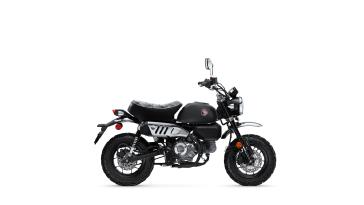
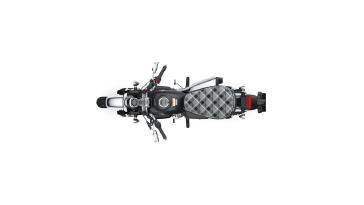
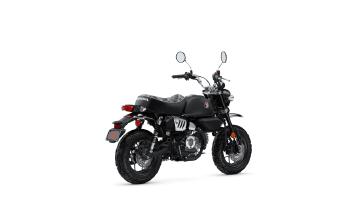
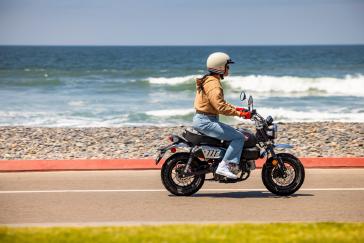
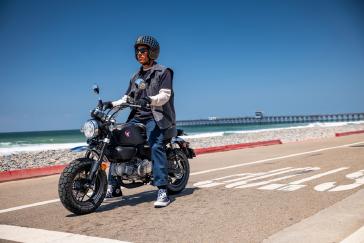
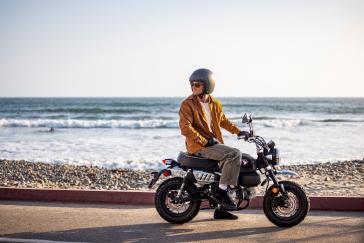
Honda's beloved Monkey offers an irresistible blend of classic charm and modern performance that has made it a favorite among a diverse array of riders. Its compact size and plush suspension make it approachable for new enthusiasts, while its capable fuel-injected engine, five-speed transmission and ABS braking deliver practical everyday usability. With a throwback silhouette, chrome accents and refined engineering, the Monkey continues to celebrate Honda's heritage while offering fun, accessible mobility for today's streets.
HISTORY
It all started in 1961 at Tama Tech, a Honda-owned amusement park founded on the same philosophy that drives Honda today: mobility through fun, two-wheel vehicles. There, Honda's 49cc-powered Z100 was featured as part of an attraction designed to help park-goers experience the joys of riding. Popular amongst guests of all ages and sizes, the bikes quickly earned the "Monkey" nickname—a reference to how larger riders looked while riding around. So popular was the attraction that, in 1964, Honda began producing a street-legal version called the CZ100, for European and Asian markets.
In 1968, the first Z50A was made available in the U.S., complete with 8-inch wheels, knobby tires, an adjustable seat, loveable styling and a folding handlebar (so that the bike could be stored in a car trunk). Outfitted with a headlight and taillight, the 1969-1970 Z50A opened the door to a wider range of riding. The trend continued, each Z50A being tweaked to fit the needs of its growing fanbase. The design continued to evolve, with dual rear shocks introduced in 1972. Honda's North America-bound Z50A models eventually morphed into machines bred for off-road riding, while Europe's Z50J carried the torch as a fun machine for getting around town.
Today, the desire for an easy-to-handle, smile-generating motorcycle is alive and well, as evidenced by the current Honda Monkey. Introduced in 2019, the model celebrates the Z50A models that paved the way while also opening the door to the next generation of enthusiasts. Fun, accessible mobility—through a likable design, tiny dimensions and low weight—is here to stay.
DESIGN / STYLING
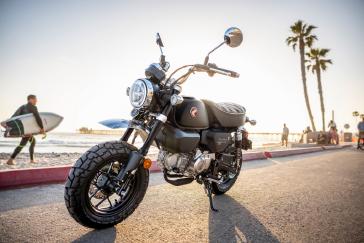
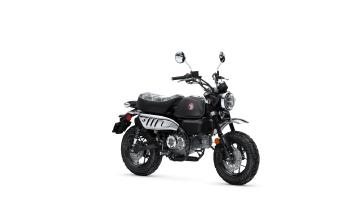
Classic Monkey styling, including curved surfaces and a trapezoid silhouette highlighting the compact length, harken back to the loveable design of the original Monkey models, putting enthusiastic smiles on the faces of riders and bystanders alike.
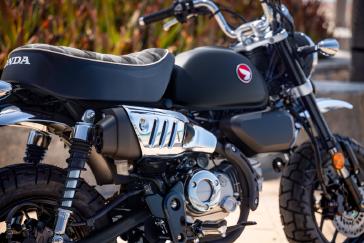
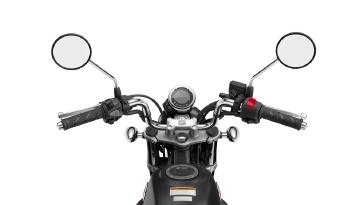
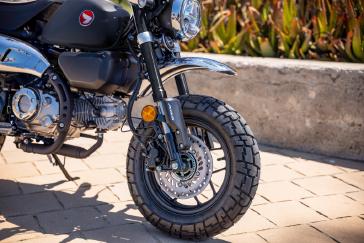
The looks are crowned by a glossy 1.5-gallon fuel tank that is finished in the same paint color as the frame, swingarm and shocks, and it's proudly adorned with a historic 3-D "Old Wing" design Honda logo (the wave-pattern key wears the "Old Wing" motif as well). Chrome steel high-mount front and rear fenders—plus the evocatively stamped exhaust shield, circular mirrors, and high-rise handlebar—all pay homage to the original Monkey.
The high-density urethane seat has a 70mm cushion, contributing to the comfortable ride and iconic looks.
Modern technology is fully present within the reincarnation of the classic look: a digital full-LCD circular meter features a speedometer, a six-segment fuel-level indicator and an odometer with two trip meters. LED lighting adds a modern touch to the classic design.
ENGINE / DRIVETRAIN
The Monkey's simple, robust power plant provides peppy acceleration from low speeds. The 123.9cc two-valve, overhead-cam, single-cylinder air-cooled engine has an undersquare design, with a narrow 50.0mm bore and long 63.1mm stroke, for good, enjoyable power all the way through the rev range. The compression ratio is 10.0:1. The engine is fed by programmed electronic fuel injection (PGM-FI). A replaceable oil filter simplifies maintenance.
The Monkey has a five-speed transmission for a wide spread of gear ratios, resulting in manageable around-town performance and comfortable cruising. The front and rear sprockets are 14 and 37 teeth, respectively.
CHASSIS / SUSPENSION
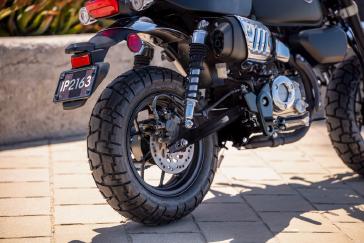
The Monkey's steel backbone frame has been tuned for a suitable balance between rigidity and supple feel—perfect for the wide variety of conditions the machine is sure to be ridden in. The head pipe, main frame and engine-hanger plate offer optimal strength for stable handling. Oval in cross-section, the swingarm echoes the circular design theme that runs through the bike.
The wheelbase is 45.0 inches, while rake and trail are 25.0° and 3.2 inches, for confidence-inspiring handling. The seat height is a low 30.5 inches, and ground clearance is 6.9 inches. The curb weight is just 231 pounds (with all required fluids and a full tank of fuel).
The 31mm inverted telescopic fork is matched by dual shocks for a compliant-yet-sporty ride. A single 220mm front disc is squeezed by a twin-piston caliper, while a single-piston caliper works the 190mm rear disc, for secure stopping performance that is managed by the IMU-based ABS. Fat, 12-inch block-pattern tires are sized 120/80-12 front and 130/80-12 69J rear, making for a smooth ride and a fun look.